Working Well, or WW, was a five year pilot begun in 2014 by the Government's Department of Work and Pensions (DWP), and run by Salford City Council on behalf of the Greater Manchester Combined Authority (GMCA), with the aim of helping long-term claimants with health conditions into work.
All participants in WW were claimants of Employment and Support Allowance (ESA) in the Work Related Activity Group (WRAG), were deemed as capable of work 'at some point in the future', and had been on the Work Programme but failed to get work.
The idea was that key workers from contracted organisations would help up to five thousand people with problems like health, debts, housing and skills before focusing on employment and then, once a job had been found, provide them with in-work support for at least twelve months.
Two companies were contracted to carry out the programme in Greater Manchester – Big Life, which was supposed to sort Salford, Manchester and Trafford, and Ingeus, which took on the other GM authority areas. And there was huge money at stake for these companies, which were paid on results.
The companies were paid £1,440 per person who joined the pilot scheme; £576 for every person who got work, and £864 for every person who stayed in work for twelve months – a potential of £2,880 per 'client', with scope for five thousand 'clients', giving a total £14.4million potential earning.
Yesterday, the Department of Work and Pensions published an early impact assessment of the pilot, by the Learning and Work Institute, which covered 53% of those referred up to August 2015. It compares those on the Working Well programme and a 'match group'...
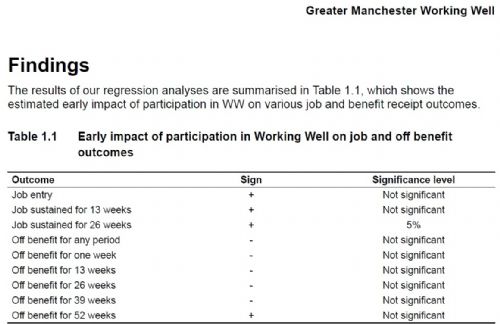
"Overall, our analysis of different job outcomes suggests that WW has not increased the chances of individuals moving into work" the authors concluded.
They added that those on WW who did manage to get a job had their time in work lengthened by 4.57 weeks, and did have an impact on being in work for 26 weeks or more...but "The pilot programme was not found to have a statistically significant impact on any periods spent off out-of-work benefits".
Statistics produced by the report show 'no significant' difference between the match group and those on Working Well in eight categories, apart from 'job sustained for 26 weeks', which had a 5% difference (see photo).
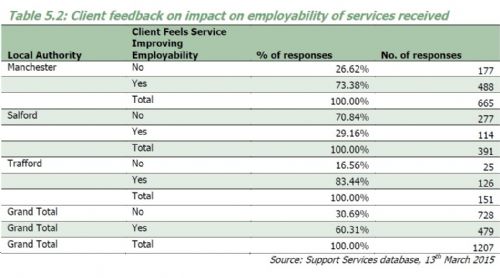
Meanwhile, in 2015, Big Life Enterprises, or Big Life, commissioned Scott Dickinson to do an interim evaluation of its delivery of the Working Well programme. While those in Manchester and Trafford thought that the programme was having a positive impact on their employability, in Salford, almost 71% (70.84%) of the 391 people sampled, said that it wasn't improving their chances of employability.
"While clients were generally positive about Working Well's approach, some clients remained uncertain as to their long-term employment prospects" that section of the report concluded.
This month, the Greater Manchester Combined Authority has appointed InWork GM (an 'alliance' of Ingeus and The Growth Company, and including Pathways CIC and Pluss) to deliver a new Working Well programme.
The programme, part of the devolution deal with the DWP and part-funded by the European Social Fund, is costing £52million and hopes to support over 22,000 people across Greater Manchester until 2024...
"The new Working Well (Work and Health Programme) will support people who are out of work due to poor health and disabilities, and will build on Greater Manchester's successful Working Well programme" states the GMCA "It has been designed to respond to one of Greater Manchester's strategic aims to reduce long term unemployment and help more residents into sustained employment.
"The Working Well (Work and Health Programme) programme will continue to fundamentally change how skills, health and employment services work together across Greater Manchester, by offering a seamless, co-ordinated and sequenced package of support to individuals to help them to address specific barriers and challenges that make it difficult to move forward" it adds.
Read the Government Report - click here
Read the Big Life report - click here




.jpg)


.jpg)
.jpg)
(3).jpeg)
.png)
(1).JPG)
