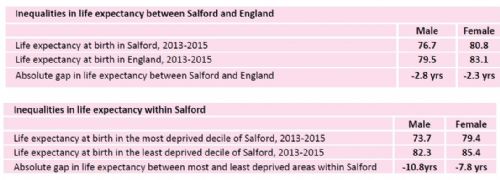
If you want to die young, Broughton is simply the only place to live, coming in first for early deaths for both men and women. Indeed, women living in Broughton can expect to die 7.8 years earlier than women in Worsley. And men living in that ward can expect to die 10.8 years earlier than Worsley males. Men in Langworthy and Barton also await the same fate.
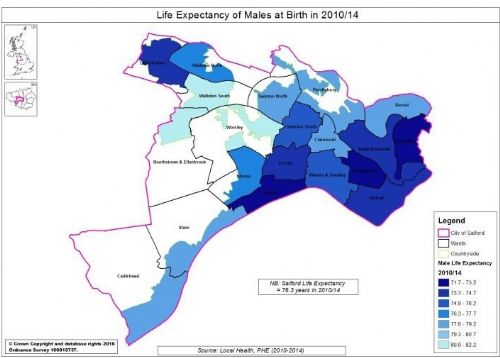
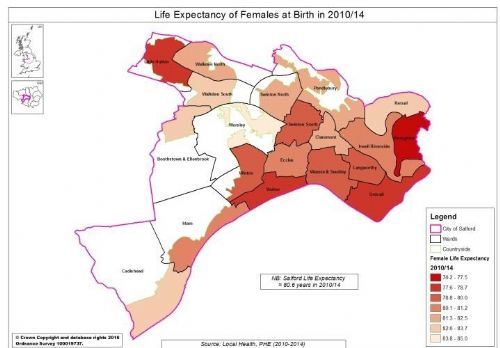
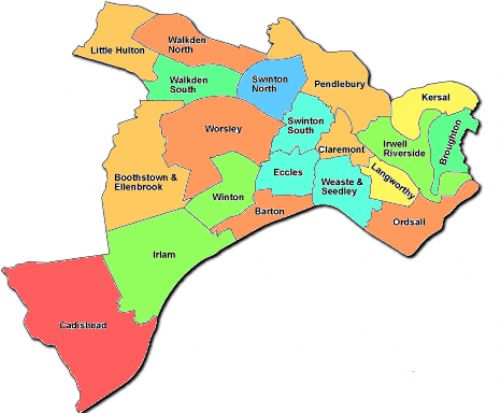
Maps produced for a new NHS Salford Clinical Commissioning Group report lay it all out in graphic detail, as the darker the ward colour, the more likely people living there will die young.
Men in Worsley, Boothstown and Walkden South can expect to live until the ripe old age of between 80.8 and 82.2, while those in Broughton, Barton and Langworthy are expected to only live to the ages of between 71.7 and 73.2. Men in Little Hulton, Irwell Riverside, Ordsall and Eccles have the second shortest life expectancy at between 73.3 and 74.7.
While Broughton has the shortest life expectancy for women (76.2-77.5), those living in Little Hulton, Ordsall and Barton are only slightly better off, expecting to live to between the ages of 77.6 and 78.7. Worsley ladies can expect to live to between 83.8 and 85.
The maps show the stark inequalities that still prevail in Salford... "There remains an inequality in life expectancy of around 8-11 years between the most advantaged and disadvantaged people of Salford" states the report by the Director of Public Health Salford
"The main causes of earlier deaths in Salford are circulatory disease, respiratory disease, cancers, digestive diseases and mental and behavioural disorders such as dementia" it adds "These conditions may be influenced by both social determinants of health and lifestyles."
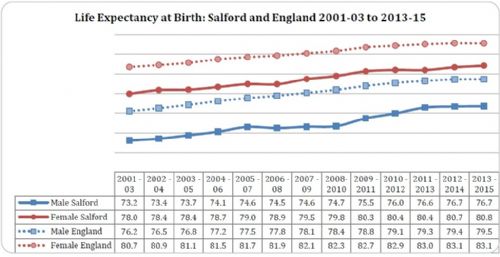
While people, in Salford are, on average, living longer – over three years longer for men and over two years for women since 2001 – the city is still two years behind the England average for life expectancy.
"The gap between Salford and the England average however persists although this gap has narrowed since the turn of the century" the report notes.
The maps show the latest official life expectancy figures, although they are from the period 2010-2014. One might expect these maps to change colour in the future, as social inequalities get diluted with all the development in Salford and influx of young professionals...
...Or, as Countryside Properties stated in its planning application for new housing in Broughton, "By introducing more market housing, which is generally occupied by a greater proportion of economically active people, there is likely to be an overall improvement in the health of the residential population of the area..."




.jpg)


.jpg)
.jpg)
(3).jpeg)
.png)
(1).JPG)
