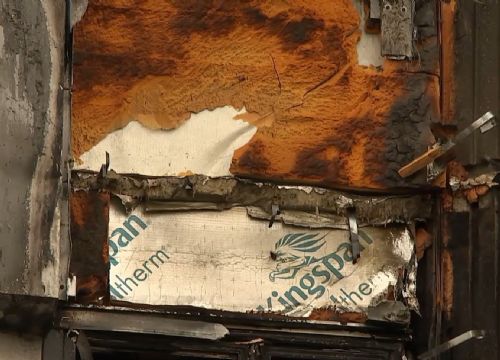
Close ups of the fire-destroyed Grenfell Tower show the charred remains of an insulation panel that is clearly branded Kingspan Kooltherm – the same insulation brand used on all nine of the Pendleton Together blocks in Salford.
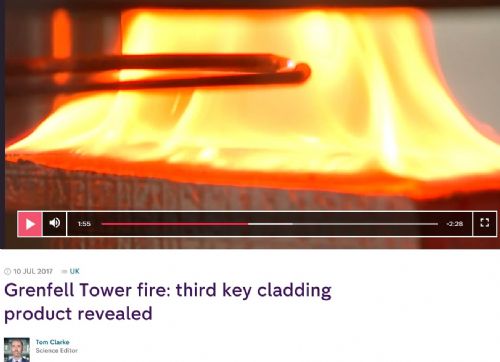
Last night Channel 4 News revealed that Kingspan Kooltherm K15 insulation was the third component of the cladding system used on Grenfell – the other two components being Reynobond outer panels and Celotex RS5000 insulation.
CH4 News Science Editor, Tom Clarke reported that Celotex RS5000 "has since been removed from sale for use on high rise buildings; Kingspan Kooltherm, like Celotex is also combustible"...
CH4 News showed an experiment that it had done with both Celotex and Kingspan insulation, subjecting the materials to temperatures consistent with an established fire... "on their foil surfaces neither material caught fire but Celotex, made of..PIR, caught fire almost instantaneously on its side...the Kingspan material of phenolic foam behaved in just the same way."*
Both products had been passed in official fire certification tests that allow them to be used in high rise buildings..."but these only apply when the insulation is tested as part of an entire cladding system" Tom Clarke added.
He explained that, while Celotex RS500 had been removed from sale for use on high buildings, as far as he knew, the Kingspan insulation hadn't been looked at "...that raises enormous questions about the investigation into the fire that happened here [Grenfell] but also the screening of materials in cladding systems across the UK..."
In a press release issued by Kingspan at the time of the refurbishment of the nine Pendleton Together blocks, it confirmed that '110mm Kingspan Kooltherm K15 Rainscreen Board' had been fitted in Salford, adding that the product "was the first insulation board to hold LABC System Approval for use in rainscreen systems. This can help to fast-track the building control checking and approval process..."
Meanwhile, the INCA - Insulated Render and Cladding Association – Best Practice Guide, written with contributions from Kingspan Insulation, includes a guide to using phenolic foam which is the key component of Kooltherm K15...
"It is easy to use, and has good fire resistance properties, although is not classed as non-combustible" the Guide states, adding, under Handling and Storage, that it "Should not be exposed to naked flame..."
Under the title Specifics, the Guide explains that "Phenolic is classed as combustible, however combustibility is limited due to retardants present..." and adds that it "Should not be left exposed for long periods of time to direct sunlight and rain" and "Should not be used if effected by rain until it has been dried out and assessed as being fit for purpose".
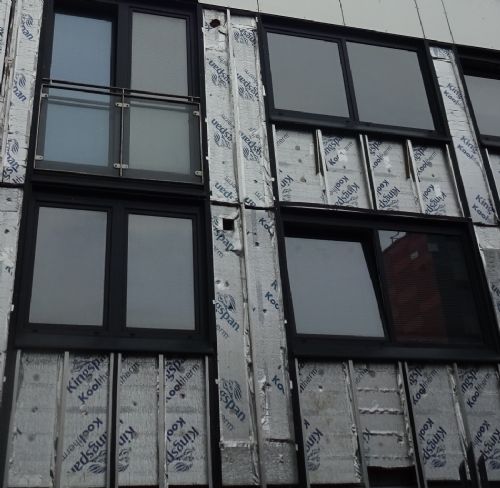
In the Salford Pendleton blocks, the outer cladding has been removed from some lower parts of the buildings and the phenolic insulation left exposed to 'rain and sunlight'...
A Kingspan spokesperson told the Salford Star...
"Kingspan recognises that the terrible tragedy at Grenfell Tower has raised understandable concerns about the implementation of building regulations, the adequacy of those regulations, the materials used in building construction and refurbishment, and how these impact one another.
Kingspan had no involvement in either the design or the specification of the refurbishment of the Grenfell Tower facade, and neither Kingspan insulated panels nor Kingspan façade systems were used on Grenfell Tower.
To the best of our knowledge, the vast majority of the insulation used for the façade refurbishment was PIR (polyisocyanurate) that had no connection with Kingspan. However, subsequent to the Grenfell tragedy we became aware that a very small quantity of Kingspan Kooltherm K15 (less than 5% of the estimated total amount of insulation used on the Tower facade) was sourced by a third party distributer and supplied to contractors involved in the refurbishment.
Whilst we are still seeking to establish the facts of what occurred, it appears that Kooltherm K15 has been used without our knowledge, as part of a combination for which it was not designed, and which Kingspan would never recommend.
Kingspan is very confident that properly installed and specified our products deliver safe, reliable and energy efficient insulation solutions.
Given the ongoing investigations by relevant authorities into the Grenfell Tower fire it would be inappropriate to comment further at this time."
To see the full Channel 4 News report – click here
See also previous related Salford Star articles...
GM Fire Service Says Remove Insulation If Can't Prove It's Safe – click here
Salford Tower Block Cladding Similar To London Fire Materials – click here
Salford Fails Most Tower Block Fire Safety Tests In Country – click here
Total Confusion Reigns Over Cladding and Insulation – click here
Salford Image Obsession and Cladding Unveiled – click here
* Update: 11:30am - Kingspan contest the Channel 4 News insulation tests - it states...
"Kingspan believes that large scale testing of complete systems is the only robust approach to fire testing. Small scale testing on individual products lacks this rigour and has the potential to significantly mislead, alarm and misinform future policy. Similarly, in our view, a reliance on so-called non- combustible materials 'deemed to' pass without any 'in use' fire testing represents a significant gap in current fire safety regulation.
"...K15, has the advantage of excellent fire performance; importantly it does not readily propagate fire and ultimately it self-extinguishes whilst substantially mitigating smoke release. Our research, using large scale fire tests on ventilated rainscreen systems shows that systems containing Kooltherm K15 can display similar fire performance to systems containing mineral fibre products that are deemed non-combustible."


(1).JPG)


.jpg)


.jpg)
.jpg)
(3).jpeg)
.png)
(1).JPG)
