Last week, at the full meeting of Salford City Council, both the City Mayor, Paul Dennett, and Paul Longshaw, Lead Member for Housing, gave speeches commendably backing the Homelessness Reduction Bill and bemoaning the lack of affordable housing in the city...
"To end the homelessness epidemic we need more socially affordable housing at fair rents" said Dennett "There is a chronic market failure in housing and we can't keep looking to profit based solutions to solve this problem..."
Paul Longshaw added "Fundamental to tackling homelessness is an increase in supply, and this means ensuring that there are enough genuinely affordable homes for people..."
Meanwhile, last Sunday night there was a documentary on BBC 2 about superyachts, the play things of the rich costing up to £30million each. The bloke on the programme, who was flogging them at Cannes and the Southampton Boat Show, said this had been a record year for sales...
...When asked why there was this increase he explained that, while the super affluent had their normal businesses, they were also making what he called "toy money" from property.
When he says "property" he isn't talking a few buy-to-let flats. For that amount he's talking towerblocks full of luxury apartments - just like the ones being planted all over the Salford border with Manchester.
And while the speculators have been making `toy money', the Salford Star has estimated over £40million in planning payments that they have avoided or evaded by stating that their developments wouldn't be `viable' if they had to cough up the money.
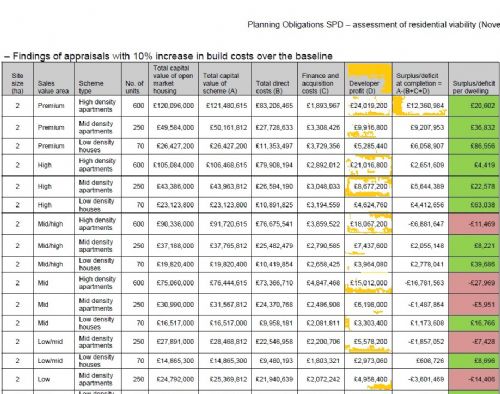
Using this ploy, the Salford Star estimated, based on Salford City Council's own figures, that the speculators have also avoided providing over one thousand affordable homes. Indeed Salford Council policy was changed only 18 months ago to make this easier for them, with developers being allowed to make up to £24million profit before `viability' calculations were made (see illustration with profits highlighted in yellow).
Now Salford Council has admitted (kind of) that it got it horribly wrong. In the Council's new Local Plan, that's currently out for consultation, it states "There is clear evidence that the high density apartment market is very successful in Salford", and that, "in response to changing levels of viability...it is anticipated that there will increasingly be the potential to deliver affordable housing as part of such schemes".
The only problem is that the new policy doesn't come into force until 2019 – by which time there won't be a scrap of Salford land near Manchester that hasn't already got planning permission with the old `viability' get-out clauses attached (see previous Salford Star article for full details – click here).
At last week's Council meeting Paul Longshaw, quite rightly, also said that "Locally we have a dysfunctional housing market...households in the city are facing a reduced range of affordable housing options..."
Again, the Salford Star has been documenting for over ten years the social engineering, or `social cleansing', that has been taking place in central Salford – in Broughton, Seedley and Langworthy, Ordsall, Pendleton and Lower Kersal and Charlestown – which was deliberate Salford Council and previous Labour Government policy. The aim was to dilute areas of predominantly social housing.
Huge swathes of the city have been basically handed over to private developers, like Countryside Properties, Urban Splash and LPC Living, to carry out the policy, which was partly known as Pathfinder and backed by Tony Blair, John Prescott and other previous Cabinet ministers.
Indeed, Countryside Properties, which has created `New Broughton', put it in black and white in a report to the Council's planning panel in October 2014, as it successfully tried to justify evading provision of affordable housing for its new private housing estate on The Meadows...
Boasting of how, at the end of its current phases of building, the `tenure split' would be 36% affordable and 64% non-affordable, or private `market accommodation', the property company stated: "It was a key aspiration of the Development Agreement to significantly reduce the proportion of affordable housing and this scheme will help achieve that aspiration..."
An area that was once made up of almost 100% houses that were affordable to the community will now be 64% unaffordable for that community.
Not only do these schemes clear vast proportions of the old community out of the area, they also mask the poverty and problems that still exist in the area. Countryside Properties, in its original planning application for `New Broughton' stated quite clearly that "By introducing more market housing, which is generally occupied by a greater proportion of economically active people, there is likely to be an overall improvement in the health of the residential population of the area."
Pendleton, on the doorstep of the University of Salford and MediaCityUK, is currently undergoing a 15 year, PFI (Private Finance Initiative) `transformation'. In the first £40million phase of the Pendleton Together project, only 110 of 300 new properties are affordable and for rent. In the overall £430million scheme, only around 500 homes out of 1500 being built will be affordable. This compares with 885 affordable properties being bulldozed.
The Business Case that went off to the Government to get the PFI grants stated that the final plans for Pendleton "will lead to a dilution in the current concentration of economically inactive households" by "young professionals and individuals who wish to live in Pendleton".
The chief Council architect of the Pendleton `regeneration' was Paul Longshaw, previously head housing officer for Salford Council before becoming a Labour Party councillor and very quickly, Lead Member for Housing and Neighbourhoods.
When asked for a comment on Facebook, Paul Longshaw responded... "Central Govt housing policy and investment through the decade and reacting to that locally ...blimey - loads have tried to nail that down and to make sense of it all."
Over the last decade the Salford Star has consistently called for a public inquiry into Pathfinder (see here) which has consistently fallen on deaf ears.
Salford Council has also backed the privatisation of council housing in the city, firstly with the City West Housing `stock transfer', and lately with the Salix Homes sell off. These companies are now almost completely out of the control of democratic accountability, with City West admitting in its recent accounts that it's looking to "maximise existing return through both good asset management but also changing the tenure and use of available stock" (see here).
The company reveals that 91 of its properties have been converted to `market rent', while its board has "has approved the acquisition of 154 PRS [Private Rent Sector] new build properties in Ordsall". In other words, the social rent charity, City West Housing, is helping to fuel unaffordable rents in the city.
All of these short-sighted Salford Council, previous Labour Government and current vicious Tory Government cuts and policies have led to an affordable housing crisis in the city, mirrored elsewhere in Greater Manchester and beyond.
Salford Council now states that it needs 734 additional affordable houses per year to head off the crisis. Last week the Council passed its `Refreshed Housing Strategy Delivery Plan', which offered few solutions in relation to affordable housing.
It stated that it would `Pilot innovative housing for under 35s' - in April 2017 - to try to stave off barbaric Government cuts to housing benefit for those under 35; that there would be one thousand affordable homes developed by 2021 (which is 200 a year, leaving a shortage of 534 affordable houses); that it will `Develop a Housing Partners Salford Pledge to ensure Right to Buy replacement ratios are effective'; and that it would be `Delivering 1,000 private sector homes, including empty privately owned homes, into the management of or leased to Salix Homes by 2020'.
The Council also stated that it will be adopting an Affordable Housing Strategy – in a year's time, December 2017!
Meanwhile, at last week's Council meeting, the Mayor declared that there would be "Council owned homes at living rent built in our city, distributed according to social need and placed outside of Right to Buy". He added that "It will not solve housing need in the city but it will be part of an overall solution."
Another solution proffered by Planning Lead Member, Councillor Derek Antrobus, at the Council meeting was the doubling of the requirement by developers to provide affordable housing, from 20% to 40% - but only on green belt land near Irlam and Cadishead, which is proposed in the city's Local Plan... "We will seek to remedy the injustice of the housing market which is denying so many young people access to the homes that they need" he thumped.
Except that the affordable homes `that they need' won't be anywhere near central Salford. They will be well out of the way in Irlam and Cadishead, with echoes of Little Hulton in the 50s and 60s, where people had travel back into the city to work.
All this social engineering is nothing new to Salford. It was seen in the 50s, 60s, 70s and, way further back, Salford based social commentator and revolutionary Friedrich Engels wrote about it 145 years ago...
"The growth of the big modern cities gives the land in certain areas, particularly in those which are centrally situated, an artificial and colossally increasing value" he explained "The buildings erected on these areas depress this value instead of increasing it, because they no longer correspond to the changed circumstances. They are pulled down and replaced by others. This takes place above all with the workers' houses which are situated centrally and whose rents...can never increase above a certain maximum.
"The result is that workers are forced out of the centre of towns towards the outskirts; that workers' dwellings...become rare and expensive and often altogether unobtainable" he added "For under these circumstances the building industry, which is offered a much better field for speculation by more expensive houses, builds workers' dwelling only by way of exception...They will provide new dwellings for hardly more than a quarter of the workers actually evicted by the building operations."
It's a lesson that should have been well learned by the current crop of Jeremy Corbyn supporters at Salford Council. But it's not.
"Plus ça change, plus c'est la même chose", or `the more things change the more they stay the same' – quote by Jean-Baptiste Alphonse Karr in 1849, roughly the same time that Engels was writing about `the housing question' in Salford and Manchester.
Tomorrow, Thursday 24th November, Greater Manchester Housing Action is hosting a public meeting on the housing crisis in Greater Manchester, as part of a programme of events organised by The GM People's Plan.
It's at Methodist Central Hall, Oldham Street, Manchester M1 1JQ and runs between 7pm and 9pm. The event is an opportunity to discuss how issues of housing and homelessness are affecting Greater Manchester, and will be led by Stephen Kingston, Editor of the Salford Star, Betsy Dillner, of Generation Rent, and Angela Barratt of Salford and Manchester Street Support.
After the initial speakers people will then split into working groups to discuss in greater detail specific areas of policy and their potential solutions. Areas to be discussed include planning priorities, social housing, regulation of the private rented sector, homelessness and alternative housing provisions.
The results of the evening will feed directly into The People's Plan. This is a free event and everyone – including Salford councillors – is welcome, although people are being asked to book tickets - click here
For further details see the Facebook event page - click here


.JPG)


.jpg)


.jpg)
.jpg)
(3).jpeg)
.png)
(1).JPG)
