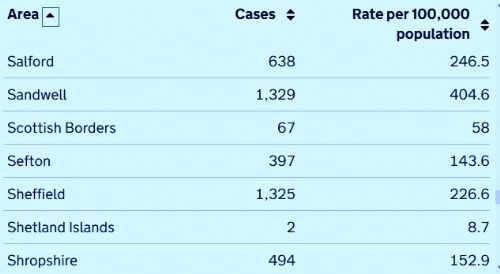
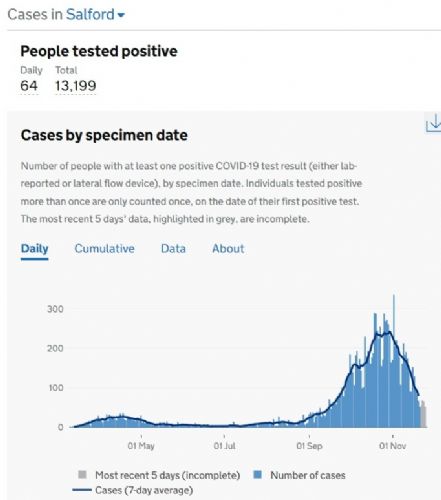
Salford has 64 new coronavirus cases, up from the previous day's 57, bringing the cumulative total to 13,199, as the overall fall in infections continues. The seven day average of cases has decreased from 673 to 638, as has the seven day rate per 100,000 population which fell from 260 to 246.5.
Elsewhere in Greater Manchester, all boroughs continue to see a slight drop in seven day totals, albeit at a high rate. Cases in Manchester during the latest seven day data period were 1,358 (down from 1,382), with a rate of 245.6 (down from 250), followed by Bolton with 847 (down from 878), with a rate of 294.6 (down from 305.3) and Oldham 873 (down from 922), with a rate of 368.2 (down from 388.8).
Wigan has 991 (down from 1,000), with a rate of 301.5 (down from 304.3), Tameside 547 (down from 567), with a rate of 241.5 (down from 250.3), Rochdale 763 (down from 805), with a rate of 343.1 (down from 361.9), Stockport 601 (down from 612), with a rate of 204.8 (down from 208.6), Bury 574 (down from 600), with a rate of 300.5 (down from 314.2) and Trafford 403 (down from 405), with a rate of 169.8 (down from 170.6).
There have been no new virus-related deaths announced by Salford Royal Hospital.
Meanwhile, a message to Salford residents from Dr Muna Abdel Aziz, Director of Public Health...
"Salford's coronavirus transmission rates have dropped significantly from the introduction of Very High restrictions on 23 October and through the national second local down which started 5 November. In the week ending 4 November, Salford's positive case rate was reported as 618.5 per 100,000 population (over a seven day period).
"By the week ending 22 November this rate had come down to 246.5 per 100,000. Salford is now approaching the average for England which was 202.4, with our local monitoring showing the rates continue to drop.
"This reduction in new cases is due to the collective efforts of everyone who lives or works in Salford. I would like to thank our communities for actively following the rules, limiting their interactions with others, and avoiding household mixing. Your efforts have made a huge difference and reduced the risk to vulnerable people in the city.
"All areas of the city and all communities were affected when we were at the peak in early November and it was not just in particular areas. This meant people were spreading the virus at work, at home and among their families. It is much harder to contain the virus in these circumstances. So again I do want to praise the community for following the advice on washing hands, wearing face coverings, keeping a distance, and in particular for staying at home when unwell. This has made all the difference.
"We need to continue this behaviour to continue to reduce levels and avoid rates increasing when shops open and in the lead up to Christmas. On 2 December, Salford along with Greater Manchester will move into Tier 3 restrictions which will continue to limit social interactions.
"I know many of you will be disappointed and I want to explain why Salford is in the top tier. Government has made decisions based on a number of measures including our overall case rate per 100,000 population, and whether it is rising or falling as well as whether it is above the national average rate for England. They have also reviewed hospital data which indicates how well the NHS is coping, the rate amongst the over 60s who are most at risk, and the level of positivity rates in local testing which indicates whether there are more people who have the virus who have not been tested.
"Salford rates are still above the England average, the over 60s infection rate is 183 per 100,000 as of 22 November, and the positivity rate is high at around 11.9% (compared to 7% in September). Hospital data shows there are still too many COVID cases in hospital and in high dependency units. The numbers of COVID cases in hospital, together with the usual winter pressures remain challenging, and the NHS continue to operate strict precautions to reduce infection to staff and other patients.
"Looking across Greater Manchester, while there has been continued improvement in weekly case rates they also remain very high, especially amongst those aged over 60, at around 260 per 100,000 people. The pressure on the local NHS is decreasing in some areas but remains a concern.
"I hope you will understand the need for continuing actions and I urge everyone next week to continue to follow the national and the Tier 3 rules and guidance in order to bring down the number of cases and keep them as low as possible. Every small change we make can have a huge impact.
"Salford's Health Protection Board will be closely monitoring the Government's key measures and ensuring we engage with communities where we are seeing high infection rates but low testing. The board would like to thank local people for their efforts and sacrifices to bring down the number of cases and urges anyone who is unwell to stay at home and get tested. Every small change we make can have a huge impact..."




.jpg)


.jpg)
.jpg)
(3).jpeg)
.png)
(1).JPG)
