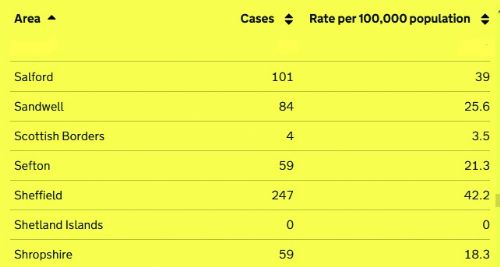
Salford has 9 new coronavirus cases, down from the previous day's 12, bringing the cumulative total of cases to 23,314. The seven day average of cases in Salford is now 101, down from 102, while the seven day rate per 100,000 population now stands at 39, down from 39.4.
Elsewhere in Greater Manchester, the seven day average of cases in Bury is 48 (up from 45), with a seven day rate per 100,000 population of 25.1 (up from 23.6); Bolton 166 (up from 143), with a rate of 57.7 (up from 49.7); Manchester 190 (down from 203), with a rate of 34.4 (down from 36.7), and Oldham 86 (up from 85), with a rate of 36.3 (up from 35.8).
Rochdale has a seven day average of cases of 71 (down from 72), with a seven day rate of 31.9 (down from 32.4); Stockport 62 (down from 68), with a rate of 21.1 (down from 23.2); Tameside 62 (down from 77), with a rate of 27.4 (down from 34); Trafford 100 (up from 97), with a rate of 42.1 (up from 40.9); and Wigan 70 (down from 73), with a rate of 21.3 (down from 22.2).
There have been no new virus-related deaths announced by Salford Royal Hospital.
Meanwhile, a new study led by Public Health England and NHS Test and Trace, could signal the end of the need to self-isolate if a contact of someone who has tested positive for the virus.
At the moment, anyone who has been notified by NHS Test and Trace as being in contact with someone who has tested positive has to self-isolate for ten days. This new study, starting on 9th May, will give up to 40,000 people the option to test themselves daily via lateral flow tests and, if negative, they can carry on as normal, going to work etc.
"People who test negative and develop no symptoms will be exempt from the legal duty to self-isolate that day and can leave their home to carry out essential activity" states Public Health England "They will need to take another test the next morning to see if they need to self-isolate that day or continue to be exempt."
This process continues for seven days, rather than having to self-isolate for ten days, and is for people aged over 18 who are not in full time education and do not have symptoms of coronavirus.
"With around 1 in 3 people not showing any symptoms, regular testing is already playing a critical role in helping us reclaim our lost freedoms - quickly spotting positive cases, helping identify new variants and squashing any outbreaks" says Health and Social Care Secretary, Matt Hancock.
"At every stage of this global pandemic, the British public has stepped up and made huge sacrifices – including self-isolating when they are asked" he adds "This new pilot could help shift the dial in our favour by offering a viable alternative to self-isolation for people who are contacts of positive COVID-19 cases, and one that would allow people to carry on going to work and living their lives. Alongside the phenomenal progress of our vaccination rollout – with over 48 million vaccines administered so far – rapid testing is allowing us to get back to doing the things we all love."
Professor Isabel Oliver, National Infection Service Director at Public Health England and study lead, adds: "We know that isolating when you have been in contact with someone who has tested positive for COVID-19 is challenging but it remains vitally important to stop the spread of infection. This study will help to determine whether we can deploy daily testing for contacts to potentially reduce the need for self-isolation, while still ensuring that chains of transmission are stopped.
"Contacts of cases are at higher risk of infection so testing them is a very effective way of preventing further spread" she says "This study will play an important part of our evaluation of daily contact testing and how the approach to testing might evolve."




.jpg)


.jpg)
.jpg)
(3).jpeg)
.png)
(1).JPG)
