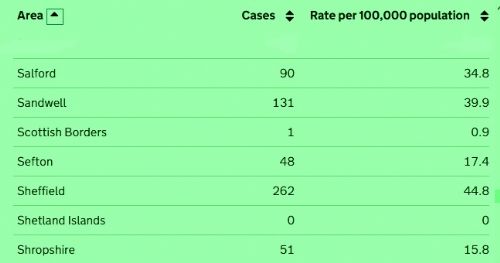
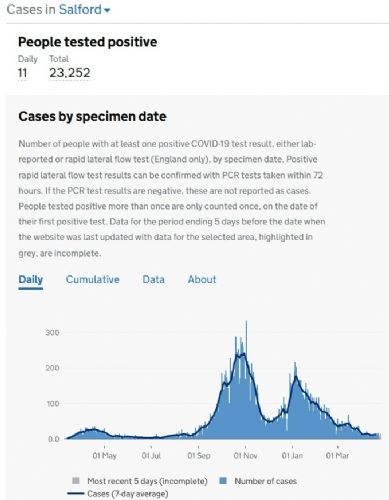
Salford has 11 new coronavirus cases, down from the previous day's 15, bringing the cumulative total of cases to 23,252. The seven day average of cases in Salford is now 90, up from 87, while the seven day rate per 100,000 population now stands at 34.8, up from 33.6.
Elsewhere in Greater Manchester, the seven day average of cases in Bury is 53 (same), with a seven day rate per 100,000 population of 27.8 (same); Bolton 133 (up from 126), with a rate of 46.3 (up from 43.8); Manchester 254 (down from 273), with a rate of 45.9 (down from 49.4); and Oldham 89 (up from 78), with a rate of 37.5 (up from 32.9).
Rochdale has a seven day average of cases of 74 (down from 75), with a seven day rate of 33.3 (down from 33.7); Stockport 81 (down from 86), with a rate of 27.6 (down from 29.3); Tameside 62 (down from 72), with a rate of 27.4 (down from 31.8); Trafford 84 (up from 81), with a rate of 35.4 (up from 34.1); and Wigan 78 (up from 77), with a rate of 23.7 (up from 23.4).
There have been no new virus-related deaths announced by Salford Royal Hospital for the 18th day in a row.
Meanwhile, after a court hearing yesterday between the Secretary of State for Housing, Communities and Local Government and Hertfordshire County Council with various local government organisations, after May 7th, councils will no longer be able to hold virtual meetings.
"It is very disappointing that this last avenue to allow councils to hold online and hybrid meetings whilst COVID-19 restrictions are still in force has not been successful. Councils by law, have to hold annual meetings within 21 days following local elections, so many will now have to use very large external venues to allow all members of the council to meet in person" says Councillor James Jamieson, Chairman of the Local Government Association.
"Councils want to continue to have powers to hold online and hybrid meetings even when restrictions have been lifted" he adds "A recent LGA survey of its members revealed that 83 per cent of councils said they would be very likely or fairly likely to conduct meetings both online and in a hybrid way once the coronavirus emergency was over if they had the power.
"The current flexibility has been paramount in allowing access for both councillors and the public into council meetings" he says "Many councils have, in fact, seen significantly increased participation by the public in meetings where important decisions are made about planning, housing and the provision of local services. Councils want the flexibility to continue to meet in this way and continue their business, especially in times of emergency such as when flooding occurs or if there is significant traffic disruption due to weather conditions.
"The Government gave clear evidence at the hearing in support of allowing the option of online and hybrid meetings" he concludes "Unfortunately, the judgement is clear that primary legislation is needed to allow councils to use technology to hold meetings."
Salford politicians aren't happy about the ruling, with Worsley and Eccles South MP Barbara Keeley tweeting "It makes no sense to force councils to drop the ability to have virtual meetings when so many people still have to work from home".




.jpg)


.jpg)
.jpg)
(3).jpeg)
.png)
(1).JPG)
