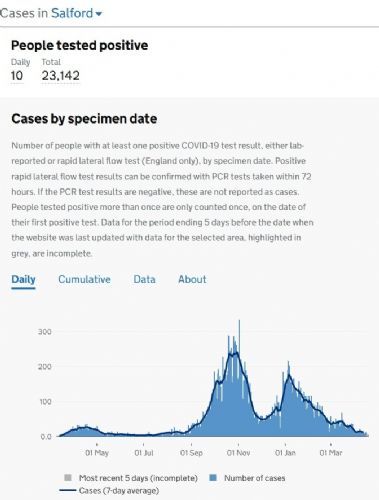
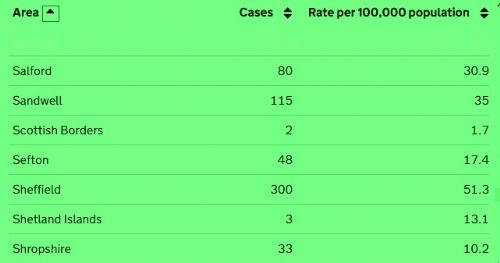
Salford has 10 new coronavirus cases, down from the previous day's 14, bringing the cumulative total of cases to 23,142. The seven day average of cases in Salford is now 80, down from 91, while the seven day rate per 100,000 population now stands at 30.9, down from 35.2.
Elsewhere in Greater Manchester, the seven day average of cases in Bury is 52 (up from 50), with a seven day rate per 100,000 population of 27.2 (up from 26.2); Bolton 137 (up from 129), with a rate of 47.6 (up from 44.9); Manchester 275 (down from 292), with a rate of 49.7 (down from 52.8); and Oldham 150 (down from 156), with a rate of 63.3 (down from 65.8).
Rochdale has a seven day average of cases of 102 (down from 112), with a seven day rate of 45.9 (down from 50.4); Stockport 79 (down from 95), with a rate of 26.9 (down from 32.4); Tameside 77 (down from 80), with a rate of 34 (down from 35.3); Trafford 73 (down from 84), with a rate of 30.8 (down from 35.4); and Wigan 124 (down from 130), with a rate of 37.7 (down from 39.6).
There have been no new virus-related deaths announced by Salford Royal Hospital.
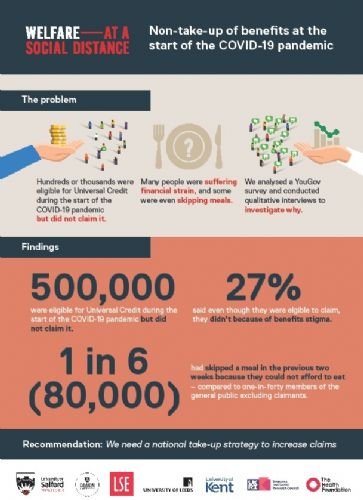
Meanwhile, a new report led by the University of Salford suggests that half a million people who were eligible for Universal Credit during the COVID-19 crisis didn't claim the benefit, despite struggling financially.
The report states that, of the estimated 430,000 to 560,000 people who were eligible for Universal Credit, around 220,000 people didn't want to claim it, with 59% stating the perceived hassle of applying and the challenge of figuring out if they were eligible the contributing factor to not applying. A further 27% didn't claim Universal Credit because of benefits stigma.
There were also an estimated 280,000 to 390,000 people who wrongly thought they were ineligible for Universal Credit, with most having a 'sense' that they were not eligible for anything.
Instead, people were relying on savings, lending money from friends and family or banks. Those not taking-up Universal Credit also had worse mental health on average than the general public, with nearly half of those interviewed reporting severe financial strain. More than one-in-six had skipped a meal in the previous two weeks because they could not afford to eat (equivalent to 80,000 people).
"Overall, the benefits system has responded well to the unprecedented demands which a year of different lockdown measures has brought. However, historic weaknesses remain" says Professor Lisa Scullion, Co-Director of SHUSU at the University of Salford and project lead.
"It is clear that there are relatively high levels of need amongst people who do not claim the benefits that they are entitled to" she adds "The Department for Work and Pensions should publish its own 'benefit take-up strategy' for the UK as a whole, aiming to ensure that people can claim the rights benefits as quickly as possible, correct misperceptions about the benefits system, and attempt to address benefits stigma."
The report was funded by the Health Foundation and links to the Welfare at a (Social) Distance project – to read the full report click here
The project is led by the University of Salford, working in collaboration with the University of Kent, the University of Leeds, the LSE and Deakin University, Australia.


.jpg)


.jpg)


.jpg)
.jpg)
(3).jpeg)
.png)
(1).JPG)
