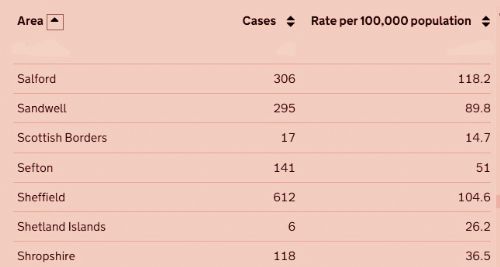
Salford has 43 new coronavirus cases, up from the previous day's 25, bringing the cumulative total to 22,565. The seven day average of cases in Salford is now 306, up from 276, while the seven day rate per 100,000 population now stands at 118.2, up from 106.6.
Elsewhere in Greater Manchester, the seven day average of cases in Bury is 162 (up from 141), with a seven day rate per 100,000 population of 84.8 (up from 73.8); Bolton 288 (down from 297), with a rate of 100.2 (down from 103.3); Manchester 531 (up from 521), with a rate of 96 (up from 94.2); and Oldham 241 (up from 246), with a rate of 101.6 (down from 103.7).
Rochdale has a seven day average of cases of 272 (down from 281), with a seven day rate of 122.3 (down from 126.3); Stockport 271 (down from 292), with a rate of 92.4 (down from 99.5); Tameside 274 (up from 272), with a rate of 121 (up from 120.1); Trafford 109 (down from 130), with a rate of 45.9 (down from 54.8); and Wigan 352 (up from 342), with a rate of 107.1 (up from 104.1).
There have been no new virus-related deaths announced by Salford Royal Hospital.
Meanwhile a new Office for National Statistics report on how people and businesses have adapted to the lockdowns shows less severe effects this time than last year. UK gross domestic product (GDP) – a measure of total economic activity – fell by 24% during the period of the first lockdown, but picked up during the subsequent lockdowns, with a 7.4% drop in November and 9% in January 2021.
"The trends in mobility and economic activity suggest that the economy is coping better with restrictions in early 2021 compared with when they were first introduced in spring 2020" states the report, which cites figures showing that "more than 80% of arts, entertainment and recreation and accommodation and food businesses were temporarily closed during the spring 2020 lockdown; this had dropped to around 55% during January 2021...In construction, around 30% of firms paused trading in spring 2020, down to less than 4% in early 2021.
"These changes are likely to be a result of businesses adapting, such as hospitality companies offering takeaway only, arts organisations streaming performances online and construction firms introducing measures to make their workplaces COVID-secure" the report states..
It adds that across all industries, around 45% of the workforce have been operating from their normal place of work during the early 2021 lockdown, down from 51% during autumn and winter 2020 restrictions but up from 36% in the first national lockdown..."Most industries have seen an increase in staff in the workplace despite renewed restrictions in autumn and winter 2020 and early 2021..."
People have also adapted to online shopping, with total sales values 6.5% below their pre-pandemic level in January 2021, compared to a 23.3% fall in April 2020... "This reduced impact is partly down to an acceleration in the long-term shift by consumers towards online shopping" states the report "The value of online retail sales has increased markedly, largely offsetting the fall in in-store sales.
"Feedback from online retailers suggests that non-essential store closures have helped boost sales" it adds "As a result, the share of online retail sales rose to a record 35.2% in January 2021, up from 19.5% a year earlier in January 2020 and 34.1% in May 2020."
To read the full report – click here




.jpg)


.jpg)
.jpg)
(3).jpeg)
.png)
(1).JPG)
