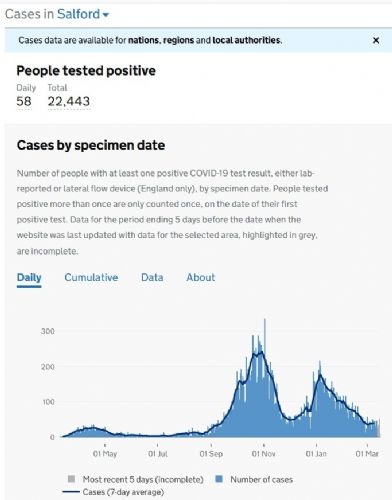
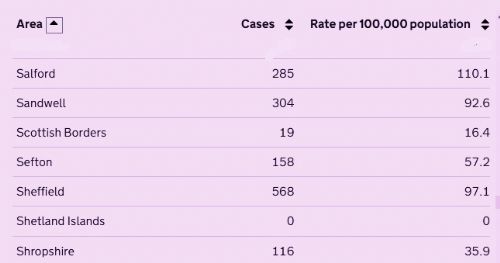
Salford has 58 new coronavirus cases, up from the previous day's 34, bringing the cumulative total to 22,443. The seven day average of cases in Salford is now 285, up from 280, while the seven day rate per 100,000 population now stands at 110.1, up from 108.2.
Elsewhere in Greater Manchester, the seven day average of cases in Bury is 131 down from 147), with a seven day rate per 100,000 population of 68.6 (down from 77); Bolton 274 (up from 261), with a rate of 95.3 (up from 90.8); Manchester 512 (up from 497), with a rate of 92.6 (up from 89.9); and Oldham 244 (up from 231), with a rate of 102.9 (up from 97.4).
Rochdale has a seven day average of cases of 283 (up from 273), with a seven day rate of 127.2 (up from 122.7); Stockport 279 (up from 271), with a rate of 95.1 (up from 92.4); Tameside 265 (down from 266), with a rate of 117 (down from 117.4); Trafford 152 (down from 154), with a rate of 64 (down from 64.9); and Wigan 316 (down from 319), with a rate of 96.1 (down from 97.1).
There has been one new virus-related death announced by Salford Royal Hospital.
At yesterday's Greater Manchester Leaders' press conference, GM Mayor, Andy Burnham said the rise in infection rates was predicted with the commencement of school testing, with the average Greater Manchester rate rising to 96.5 in the week ending 12th March, up from 88.7 the previous week...
"We don't want to say that's the only reason, there may be more complex reasons behind the change" he explained "but it is clearly a very significant factor that needs to be taken into account...It's a changed picture and one we've got a close watch on...a bumpy picture."
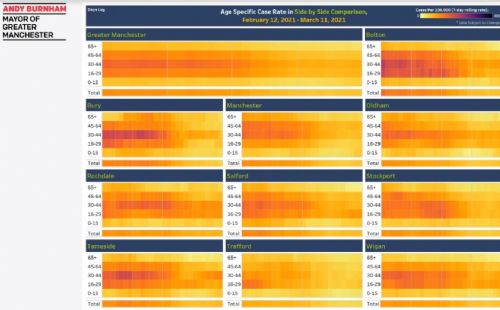
As a result of school testing, figures show a big increase, with Salford Pillar 2 testing per 100,000 population almost doubling, from 6,798 tests in the week ending 6th March, to 11,717 in the week ending 13th March. The age heat map of infection for Greater Manchester shows the main increase in cases within the 16 to 29 age group and the working age population (see graphics).
As a result of vaccines and lockdowns, Greater Manchester hospitals are now seeing a definite easing of pressure, with statistics similar to last October. Weekly COVID-19 admissions to hospitals and in-patient diagnosis of the virus have fallen from 254 on 8th March, to 215 on 15th March, while the number of beds occupied by COVID-19 patients has fallen from 426 to 365 over the same period, with the number of COVID-19 patients in intensive care decreasing from 93 to 77.
Greater Manchester has now vaccinated 1,026,030 people. 92% of over 70s have now had the jab, with 63% of those aged 50 to 69, and 32% of those aged 18 to 49. The programme is now also moving towards second jabs for those in the older cohorts who are reminded to look up their appointments.
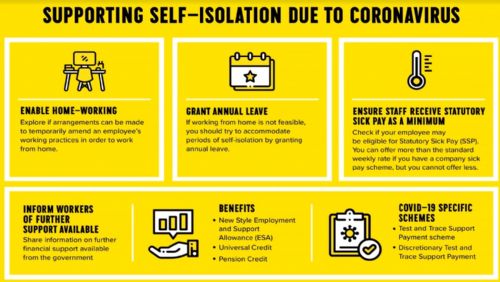
Andy Burnham made a plea to Greater Manchester employers to support their employees to self-isolate..."It's timely because in recent days the Government has announced that the testing regime is now available to companies of all sizes can order Lateral Flow Testing kits" he said.
"We would encourage companies to take advantage of that but in doing so we would ask them to make a commitment to supporting people who do test positive who then may need to self-isolate – both for income and job protection" he added "The Manchester Growth Company is getting messages out that there is support for employees out there." (see graphic)


.jpg)
.jpg)
.jpg)
.jpg)
.jpg)
.jpg)


.jpg)


.jpg)
.jpg)
(3).jpeg)
.png)
(1).JPG)
