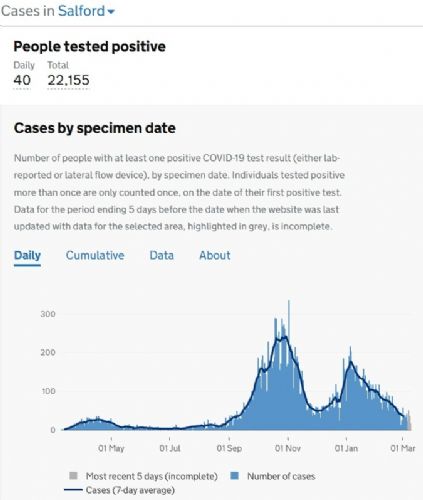
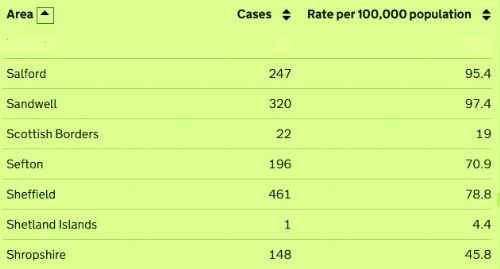
Salford has 40 new coronavirus cases, down from the previous day's 56, bringing the cumulative total to 22,155. The seven day average of cases in Salford is now 247, down from 251, while the seven day rate per 100,000 population now stands at 95.4, down from 97.
The infection rate continues to fall in Salford, although residents in Higher Broughton have had alerts asking them to take a test as 'the virus is spreading in Broughton'.
Elsewhere in Greater Manchester, the seven day average of cases in Bury is 166 (down from 167), with a seven day rate per 100,000 population of 86.9 (down from 87.4); Bolton 295 (down from 303), with a rate of 102.6 (down from 105.4); Manchester 439 (down from 481), with a rate of 79.4 (down from 87); and Oldham 188 (down from 199), with a rate of 79.3 (down from 83.9).
Rochdale has a seven day average of cases of 260 (down from 265), with a seven day rate of 116.9 (down from 119.1); Stockport 241 (down from 253), with a rate of 82.1 (down from 86.2); Tameside 229 (up from 219), with a rate of 101.1 (up from 96.7); Trafford 129 (down from 141), with a rate of 54.3 (down from 59.4); and Wigan 311 (same), with a rate of 94.6 (same).
There have been no new virus-related deaths at Salford Royal Hospital.
Meanwhile, at yesterday's Greater Manchester Leaders' press conference, GM Mayor, Andy Burnham, relayed statistics that showed "an improved picture" in the region, saying they were the best virus infection figures since last September, although Greater Manchester, with an average seven day rate of infection per 100,000 population of 88.2 is still above the national average of 60.8.
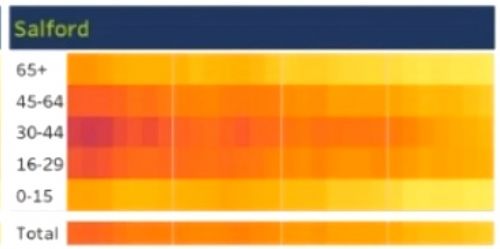
While care home residents with COVID-19, or showing symptoms of the virus, remains stable at 1.8%, the heat map of infections for the region shows almost bright yellow for those over 65 in Salford and in most of Greater Manchester, meaning infection rates are almost at their lowest, and that the vaccinations are now having an effect. It was formerly dark purple at times (see graphics).
Infection rates and cases are falling, while more testing is being done. Salford, for instance, carried out 6,798 Pillar 2 tests in the week ending 6th March, compared to 4,883 tests in the preceding week.
Case numbers are, however expected to rise next week, reflecting the increased testing being done as school and college students return... "It doesn't necessarily reflect a change of position in respect of the spread of the virus just simply that there's going to be a lot more testing being done" said Burnham.
In Greater Manchester hospitals, weekly admission numbers for COVID-19 patients and in-patients diagnosis have decreased from 360 on the week ending 1st March, to 254 on week ending 8th March.
The number of beds taken up with COVID patients in the hospitals was 426 on 9th March, compared with 519 on 2nd March, while the number of COVID patients in intensive care beds has also dropped from 101, to 93 during this period.
"You can see now a sustained reduction in pressure on the system" said Burnham "Still a reasonably high number of patients in critical care and, of course, in general beds but this is a changed picture now and does represent a reasonable easing of pressure in the NHS...down considerably from where we were in early January and February.
"And because of this we are talking to NHS colleagues now about the resumption of planned elective care coming back in" he added "It's due to start in the next week or so."
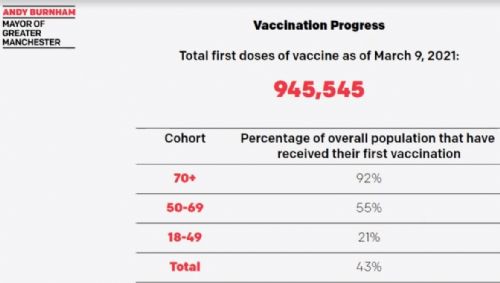
One million people in Greater Manchester are now expected to have been vaccinated by the end of this week, with almost half of the adult population in the region having the jab. Second doses of the vaccine are set to start over the coming week.
"The light at the end of the tunnel just got a little bit brighter" Andy Burnham concluded "It's an improving picture and it's tempting to want to speed things up but I do think we need to listen to the Chief Medical Officer and the directors of public health. We're getting on top of this but I think it's a steady as we go approach at this stage.
"We need to see that situation in schools settle; we need to be sure of what that's done to the R number before we call for any acceleration of things, so it's encouraging and let's make this the last lockdown" he added, paying tribute to the public and health staff who have facilitated the improved situation "Let's not throw away the good progress being made..."
For details on how young people are losing 'hope and optimism' during the coronavirus crisis see previous Salford Star article – click here


.jpg)
.jpg)
.jpg)
.jpg)
.jpg)


.jpg)


.jpg)
.jpg)
(3).jpeg)
.png)
(1).JPG)
