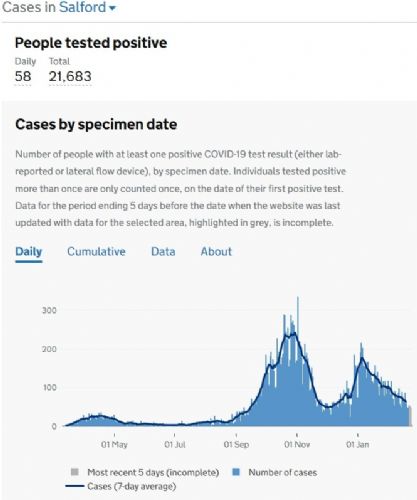
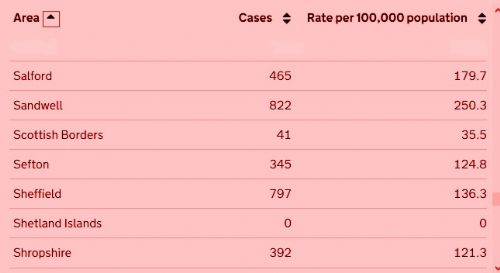
Salford has 58 new coronavirus cases, up from the previous day's 49, bringing the cumulative total to 21,683. The seven day average of cases in Salford has stayed the same at 465, as has the seven day rate per 100,000 population which now stands at 179.7.
Elsewhere in Greater Manchester, the seven day average of cases in Bury is 436 (down from 448), with a seven day rate per 100,000 population of 228.3 (down from 234.6); Bolton 655 (down from 682), with a rate of 227.8 (down from 237.2); Manchester 965 (up from 960), with a rate of 174.5 (up from 173.6); and Oldham 356 (up from 347), with a rate of 150.1 (up from 146.3).
Rochdale has a seven day average of cases of 401 (up from 385), with a seven day rate of 180.3 (up from 173.1); Stockport 538 (down from 540), with a rate of 183.4 (down from 184); Tameside 449 (up from 442), with a rate of 198.2 (up from 195.1); Trafford 318 (up from 313), with a rate of 134 (up from 131.9); and Wigan 546 (down from 558), with a rate of 166.1 (down from 169.8).
Half of the Greater Manchester boroughs have seen 7 day infection rates rising slightly, in line with certain other parts of the country.
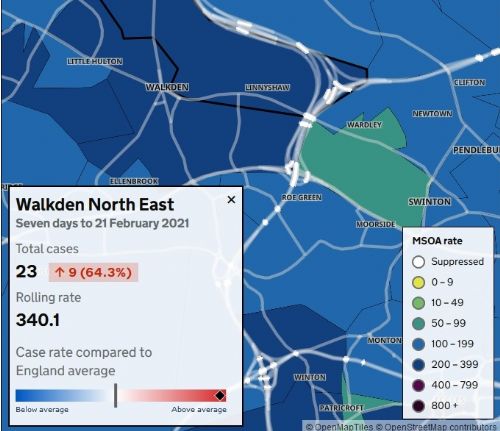
Within Salford, the areas of Little Hulton and Walkden have the highest rates of infection, according to the latest interactive map published by the Government yesterday and showing cases in the seven days up to 21st February...
Highest rates...
Walkden North East – 23 new cases, with a rolling rate 340.1
Little Hulton South – 24 cases, rate 336.3
Walkden North West – 20 cases, rate 324.7
Walkden South – 29 cases, rate 305.6
Kersal Dale - 19 cases, rate 264.4
Broughton Park – 18 cases, rate 246.3
Lowest rates...
Langworthy Buile Hill – 4 new cases, with a rolling rate of 59.1
Lower Irlam and Cadishead – 7 cases, rate 67.1
Patricroft – 5 cases, rate 73.6
Swinton West – 5 cases, rate 83.8
Pendleton – 6 cases, rate 91.7
To view the interactive map – click here and enter a postcode
In America, New York Times science writer, Apoorva Mandavilli, spoke to 21 experts about the future of the pandemic and, while most were optimistic about the mid to long term future, they were worried about a 'fourth wave'; with new variants causing a 'pandemic within a pandemic'...
"We have the larger pandemic - the thing we've been dealing with since last year - and that is winding to a close" she said "But in the meantime, these variants have created a new set of problems.
"The biggest variable is behaviour" she adds "and it explains both why cases have fallen so much in most of the world, but also why they might go up again."
It was echoing a message yesterday from Chris Whitty, Chief Medical Officer for England, who, while lowering the alert level for the virus, from 5 to 4, added...
"We should be under no illusions – transmission rates, hospital pressures and deaths are still very high. In time, the vaccines will have a major impact and we encourage everyone to get vaccinated when they receive the offer. However, for the time being it is really important that we all – vaccinated or not – remain vigilant and continue to follow the guidelines."
There have been no new virus-related deaths at Salford Royal Hospital, and, although cases still remain relatively high, the pressure from COVID patients at Salford Royal certainly seems to be dropping.
Latest data shows 70 hospital admissions and in-patient diagnosis for the week ending 21st February, compared to 96 in the week ending 14th February. The actual number of COVID patients occupying beds at Salford Royal has also dropped from 173 on 3rd February, to 147 on 10th February, to 137 on 17th February, to 116 on 23rd February.
There were 13 COVID patients in Salford Royal's intensive care 'mechanical ventilation' beds on 23rd February, compared to 19 the week before, and numbers in the high twenties for weeks previous to that.




.jpg)


.jpg)
.jpg)
(3).jpeg)
.png)
(1).JPG)
