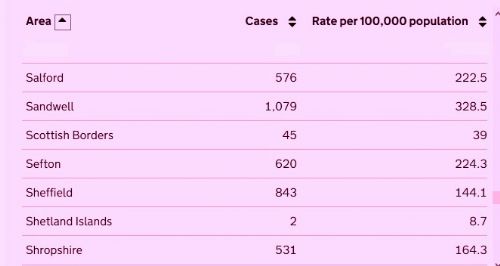
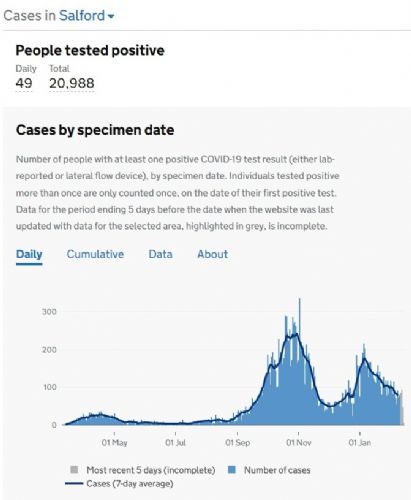
Salford has 49 new coronavirus cases, down from the previous day's 103, bringing the cumulative total to 20,988. The seven day average of cases in Salford has decreased to 576, down from 579, while the seven day rate per 100,000 population now stands at 222.5, down from 223.7.
Elsewhere in Greater Manchester, the seven day average of cases in Bury is 391 (down from 403), with a seven day rate per 100,000 population of 204.7 (down from 211); Bolton 795 (down from 814), with a rate of 276.5 (down from 283.1); Manchester 1,119 (down from 1,185), with a rate of 202.4 (down from 214.3); and Oldham 449 (down from 475), with a rate of 189.4 (down from 200.3).
Rochdale has a seven day average of cases of 440 (up from 433), with a seven day rate of 197.8 (up from 194.7), Stockport 555 (down from 584), with a rate of 189.1 (down from 199); Tameside 417 (down from 418), with a rate of 184.1 (down from 184.6); Trafford 343 (down from 375), with a rate of 144.5 (down from 158); and Wigan 586 (down from 625), with a rate of 178.3 (down from 190.2).
.
There has been one new virus-related death at Salford Royal Hospital.
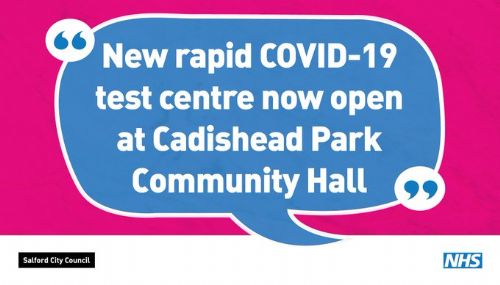
Meanwhile, a new rapid COVID-19 testing centre has opened at Cadishead Park Community Hall for people aged over 16 with no symptoms of the virus and who can't work from home during lockdown. To book a twice weekly test – click here
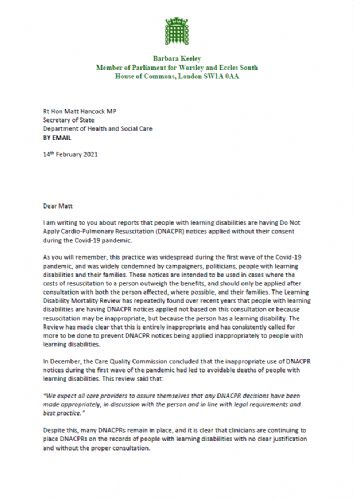
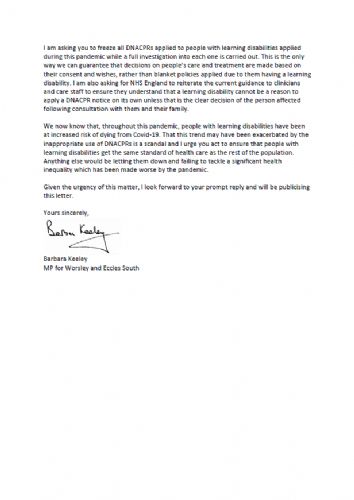
Worsley and Eccles South MP, Barbara Keeley, has written to Health Secretary, Matt Hancock, asking him to freeze all DNACPR (Do Not Apply Cardio-Pulmonary Resuscitation) notices applied to people with learning disabilities during the pandemic while "a full investigation into each one is carried out"...
The 'do not resuscitate' orders are only supposed to be used only after consultation with the person and their families, where possible, and where resuscitation isn't appropriate, but the Learning Disability Mortality Review found that the orders were applied in many cases without these criteria.
The Care Quality Commission has also concluded that the use of the orders during the first wave of the pandemic led to avoidable deaths and stated that "We expect all care providers to assure themselves that any DNACPR decisions have been made appropriately, in discussion with the person and in line with legal requirements and best practice..."
However, Keeley writes, "many DNACPRs remain in place, and it is clear that clinicians are continuing to place DNACPRs on the record of people with learning disabilities with no clear justification and without proper consultation".
She concludes: "We know that, throughout this pandemic, people with learning disabilities have been at increased risk of dying from COVID-19. That this trend may have been exacerbated by the inappropriate use of DNACPRs is a scandal and I urge you to ensure that people with learning disabilities get the same standard of health care as the rest of the population..."




.jpg)


.jpg)
.jpg)
(3).jpeg)
.png)
(1).JPG)
