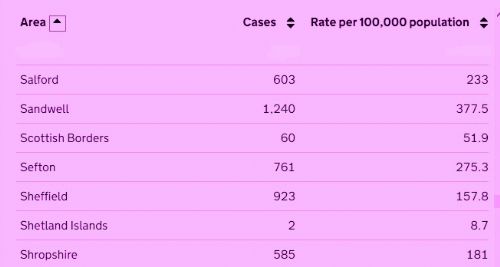
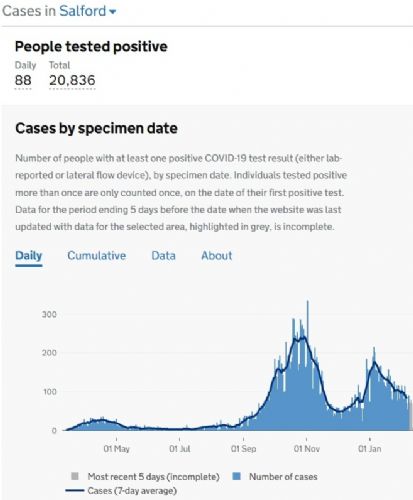
Salford has 88 new coronavirus cases, up from the previous day's 74, bringing the cumulative total to 20,836. The seven day average of cases in Salford has decreased to 603, down from 629, while the seven day rate per 100,000 population now stands at 233, down from 243.
Elsewhere in Greater Manchester, the seven day average of cases in Bury is 404 (up from 402), with a seven day rate per 100,000 population of 211.5 (up from 210.5); Bolton 806 (down from 830), with a rate of 280.3 (down from 288.6); Manchester 1,244 (down from 1,312), with a rate of 225 (down from 237.3); and Oldham 510 (up from 500), with a rate of 215.1 (up from 210.9).
Rochdale has a seven day average of cases of 454 (down from 491), with a seven day rate of 204.1 (down from 220.8); Stockport 599 (down from 614), with a rate of 204.1 (down from 209.3); Tameside 407 (up from 406), with a rate of 179.7 (up from 179.3); Trafford 378 (down from 399), with a rate of 159.3 (down from 168.1); and Wigan 644 (down from 661), with a rate of 195.9 (down from 201.1).
.
There has been one new virus-related death at Salford Royal Hospital.
Meanwhile, GM Mayor Andy Burnham, has again labelled the self-isolation support scheme as the "Achilles Heel of Britain's response to the pandemic", after this week's experience of containing the new strain of virus in Moss Side.
"It's a deprived part of Manchester and a lot of people have got low paid jobs. A lot of them are working on zero hours contracts and, when you have to self-isolate, it's easy for your employer to say well just don't come in then and you lose everything" Doctor Aneez Esmail, a local GP and a practitioner at the University of Manchester, told BBC Radio Manchester "I think that is the biggest problem. Unless we can find a means of supporting them, then people won't."
And Burnham emphasised..."The lack of a proper self-isolation support scheme has always been the Achilles Heel of Britain's response to the pandemic. It is now the single biggest hole in our national defences and the greatest threat to our ability to return to a more normal life in 2021.
"Our experience in Moss Side tells us that the country will not be able to contain these new, highly-transmissible strains if people cannot self-isolate instantly without fear of losing income or their job" he explains "Many workplaces based on low-wage, insecure employment - such as warehouses and food processing sites - have been allowed to remain open throughout the pandemic even though the support has never been in place to prevent the risk of spread. This is one of the reasons why COVID-19 has taken such a hold in some of our poorer communities.
"It is essential that the Government listens to SAGE and fixes this issue now in advance of any unlocking" he concludes "It is not just a question of money. People need to be able to self-isolate safe in the knowledge that they will have a job to return to when their period of isolation is over. That job protection needs to be enshrined in law as well as providing full wage support for the lowest-paid. Failure to fix these problems will delay the reopening of the economy and the return of a more normal life, which so many people are desperately waiting to see."
As well as fixing the financial compensation, Burnham is also calling for 'proactive information, social and clinical support'; 'Sufficient supplies of food and other essential goods'; and 'employment protection'.




.jpg)


.jpg)
.jpg)
(3).jpeg)
.png)
(1).JPG)
