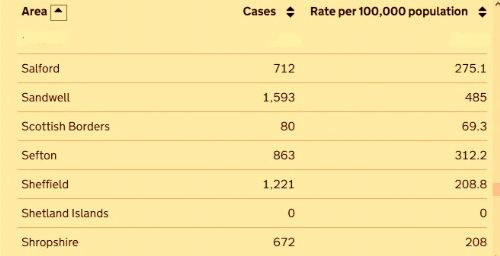
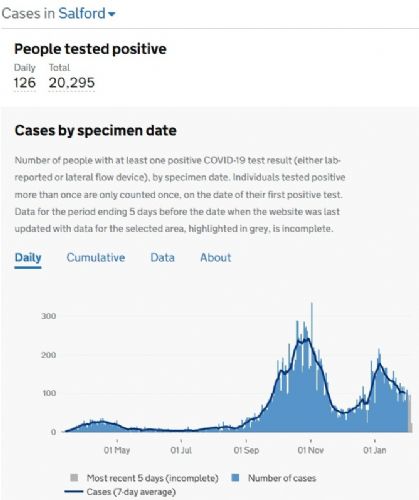
Salford has 126 new coronavirus cases, up from the previous day's 77, bringing the cumulative total to 20,295. The seven day average of cases in Salford has decreased to 712, down from 728, while the seven day rate per 100,000 population now stands at 275.1, down from 281.3.
Elsewhere in Greater Manchester, the seven day average of cases in Bury is 429 (down from 438), with a seven day rate per 100,000 population of 219.9 (down from 229.3); Bolton 799 (up from 785), with a rate of 277.9 (up from 273); Manchester 1,577 (down from 1,613), with a rate of 285.2 (down from 291.8); and Oldham 516 (down from 559), with a rate of 217.6 (down from 235.8).
Rochdale has a seven day average of cases of 565 (same), with a seven day rate of 254 (same); Stockport 684 (down from 714), with a rate of 233.1 (down from 243.3); Tameside 568 (down from 601), with a rate of 250.8 (down from 265.4); Trafford 491 (down from 513), with a rate of 206.9 (down from 216.1); and Wigan 835 (down from 849), with a rate of 254.1 (down from 258.3).
There have been no new virus-related deaths at Salford Royal Hospital. There were 172 COVID-19 patients in the hospital on the last day of data, 2nd February, as numbers look to be stable over the last week, with 25 COVID patients in mechanical ventilation beds, similar to numbers over the last week.
Hospital admissions data lags a bit behind, but on 29th January, 14 COVID patients were admitted to the hospital, compared to 28 on 28th January, 18 on 27th January and 28 on 26th January. Meanwhile, infections in the over 60s in Salford are also decreasing with 102 cases and a rolling 7 day rate of 209.3 on 1st February, compared to 113 cases and a rolling rate of 231.8 the week before.
Overall in Salford, numbers are dropping in all categories – but dropping at a very slow rate compared to the rest of the country.




.jpg)


.jpg)
.jpg)
(3).jpeg)
.png)
(1).JPG)
