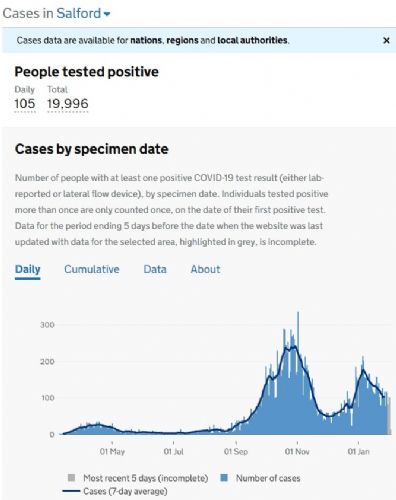
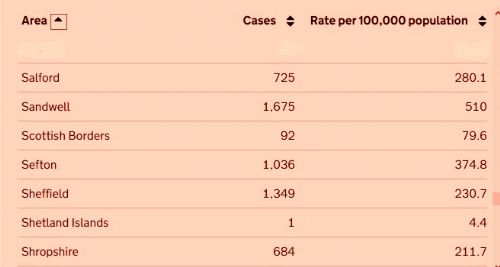
Salford has 105 new coronavirus cases, down from the previous day's 111, bringing the cumulative total to 19,996. The seven day average of cases has increased to 725, up from 710, while the seven day rate per 100,000 population now stands at 280.1, up from 274.3.
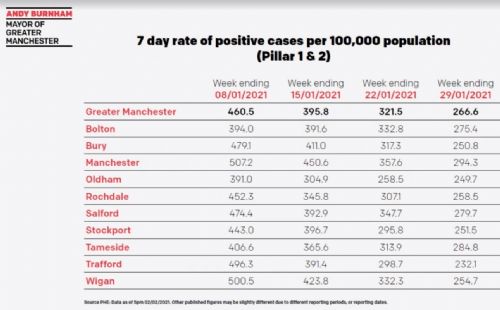
Elsewhere in Greater Manchester, the seven day average of cases in Bury is 479 (down from 506), with a seven day rate per 100,000 population of 250.8 (down from 264.9); Bolton 796 (up from 789), with a rate of 276.8 (up from 274.4); Manchester 1,630 (down from 1,659), with a rate of 294.8 (down from 300.1); and Oldham 592 (down from 610) with a rate of 249.7 (down from 257.3).
Rochdale has a seven day average of cases of 576 (down from 578), with a seven day rate of 259.6 (down from 259.9); Stockport 739 (up from 760), with a rate of 251.9 (up from 259); Tameside 646 (down from 655), with a rate of 285.2 (down from 289.2); Trafford 551 (down from 560), with a rate of 232.1 (down from 235.9); and Wigan 837 (down from 863), with a rate of 254.7 (down from 262.6).
There have been no new virus-related deaths at Salford Royal Hospital.
Meanwhile, at yesterday's Greater Manchester Leaders' press conference, GM Health Leader, Richard Leese, said that Greater Manchester had reached the peak of infections and hospital admissions but modelling suggests that the region will remain at a high level plateau for around three weeks. The vaccination programme should also have a positive impact on hospital admissions in two to three weeks.
On 1st February, COVID admissions to Greater Manchester hospitals and in-patient diagnosis fell to 773, from 999 on 25th January, while the number of COVID patients occupying beds fell from 1,133 on 26th January, to 1,016 on 2nd February. The number of COVID patients in intensive care rose slightly from 165 to 170 over the same period.
Professor Kate Ardern, Director of Public Health in Wigan, added that the new easier transmissible variants of mutant virus are not something to be worried about on their own "but they are something to reinforce all of the public health measures we have in place...all vaccines we have to date are effective against the South African variant and the Kent variant".
Greater Manchester infections are falling much slower than the national rate because the region began this wave at much higher rates than the national average, she added.
Cases are rising in some instances because there is a lot more targeted mass lateral flow testing. Salford PCR and lateral flow tests have increased from 3,569 on 16th January to 4,673 on 30th January. Richard Leese pointed out that if someone tests positive twice in a week on the lateral flow tests they are counted twice too, which skews the figures.
Meanwhile, 441,044 people in Greater Manchester had their first doses of vaccine by 3rd February, around 80% of those eligible but there is no data on how many people have been invited to have the jab but haven't taken it up, nor on the reasons why they haven't taken up the offer. Domiciliary care workers and special school teachers have now been added to the priority cohort for vaccinations in Greater Manchester.
The GM Leaders are now looking at pathways out of lockdowns and restrictions, and Greater Manchester Mayor, Andy Burnham, called for a strengthening of the test, trace and isolate system.
While Greater Manchester has pioneered a local contact tracing system which has successfully reached more than 16,000 people who had not been reached by the national tracing system, and traced almost 4,200 people in complex and high risk settings, the weak link is the isolation side of things, he explained.
Citing the head of test and trace, Dido Harding, who stated that there are around 20,000 people a day not isolating who should be, Burnham added that 70% of people who apply for financial support to self-isolate are being turned down.
"Vaccination is progressing well, but as we look to the rest of the year as we navigate our exit from the situation, we're going to need a strong contact tracing system without the gaps of last year" he said "...The testing element of test and trace is working significantly better than it was...the bit that really isn't working is the isolate part, which unpicks the whole chain."
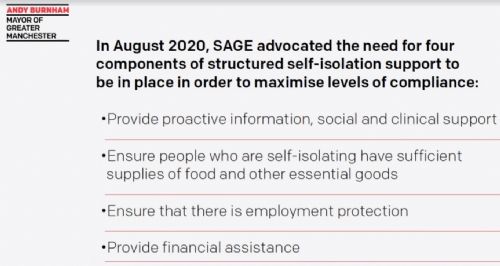
He quoted the advice from the Government scientific advisory body, SAGE, which advocated the four components that need to be in place to maximise levels of compliance...information and clinical support; an assurance that those self-isolating have supplies of food and essentials; and that there is employment protection and financial assistance.
"We've got a messy situation at the moment that isn't working" he explained "What we need is a simple national solution that guarantees the wages of people who currently would not be able to qualify for support...Fixing isolation support is now a top issue as far as we are concerned...This needs to be in place before national unlocking happens, so that we have a contact tracing and isolation system that is ready for the job..."


.jpg)
.jpg)
.jpg)
.jpg)

.jpg)


.jpg)


.jpg)
.jpg)
(3).jpeg)
.png)
(1).JPG)
