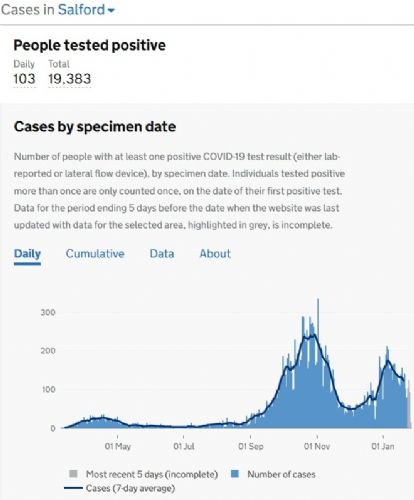
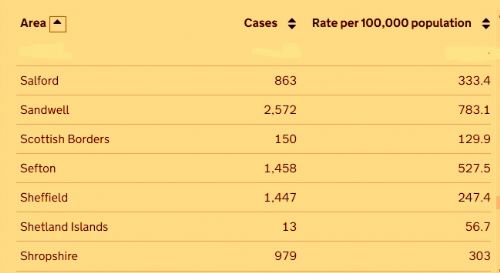
Salford has 103 new coronavirus cases, down from the previous day's 126, bringing the cumulative total to 19,383. The seven day average of cases has decreased to 863, down from 898, while the seven day rate per 100,000 population now stands at 333.4, down from 346.9.
Elsewhere in Greater Manchester, the seven day average of cases in Bury is 571 (down from 605), with a seven day rate per 100,000 population of 299 (down from 316.8); Bolton 921 (down from 955), with a rate of 320.3 (down from 332.1); Manchester 1,889 (down from 1,974), with a rate of 341.7 (down from 357.1); and Oldham 606 (down from 613), with a rate of 255.6 (down from 258.5).
Rochdale has a seven day average of cases of 657 (down from 682), with a seven day rate of 295.4 (down from 306.6); Stockport 843 (down from 866), with a rate of 287.3 (down from 295.1); Tameside 704 (down from 710), with a rate of 310.8 (down from 313.5); Trafford 710 (same), with a rate of 299.1 (same); and Wigan 1,059 (down from 1,092), with a rate of 322.2 (down from 332.3).
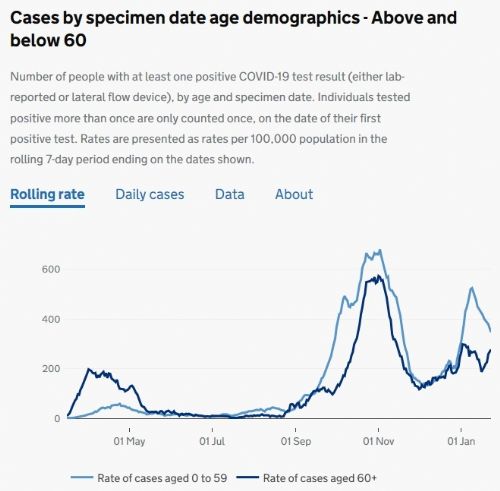
The rate of infections in Salford people over 60 are rising, as the rate of those under 60 are falling. During the week 17th to 23rd January, the rolling rate of infection per 100,000 population in the over 60s increased from 197 to 277, while the rolling rate for under 60s fell from 414.1 to 346.5, although the vast majority of cases are still in the under 60s.
There have been two new virus-related deaths at Salford Royal Hospital.
Meanwhile, teachers' union, the NEU, or National Education Union, has launched a three part Education Recovery Plan. The first part is about educating students safely, by creating safer educational workplaces and continuing remote learning where necessary. It includes recommendations on social distancing, face coverings, vaccines and ventilation, rotas and remote education...and an acceptance "that a full return by all students may not be possible for some time".
The second part of the plan contains proposals to build a better education system, and the third part is a call to fight child poverty.
To read the full recovery plan – click here
"We all want schools and colleges to be fully open again, but this needs to be properly planned with measures in place to address the problems already encountered and to ensure a safe and sustained return" says Dr Mary Bousted, Joint General Secretary of the National Education Union "That is why we are launching our education recovery plan, which sets out a substantial strategy for schools and colleges to emerge from lockdown in a way that is safe and sustainable.
"Unions, school leaders, teachers and staff are tired of last-minute guidance and u-turns" she adds "Families, also, have been stung once too often by false hope. Government must now initiate structured talks with education unions, based upon all available evidence, about how a phased return is best managed, irrespective of whether that is 8th March or not.
"School leaders can then begin making arrangements, confident that their time is not being wasted and that there is real potential for long-term solutions" she explains "The NEU would enter such talks with a determination to make our recovery plan a reality, benefiting staff and pupils alike.
"Simply declaring schools and colleges COVID-secure does not make them so" she concludes "With a death toll of 100,000 a stark reminder of the seriousness of our situation, and with no clear way out of lockdown, it is incumbent on Boris Johnson to finally change tack. We offer this updated plan to the Prime Minister in the spirit in which the first was intended – to secure a safe and uninterrupted return to education for all."




.jpg)


.jpg)
.jpg)
(3).jpeg)
.png)
(1).JPG)
