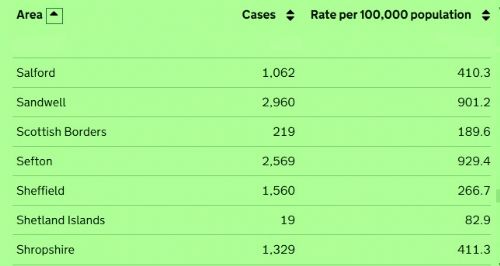
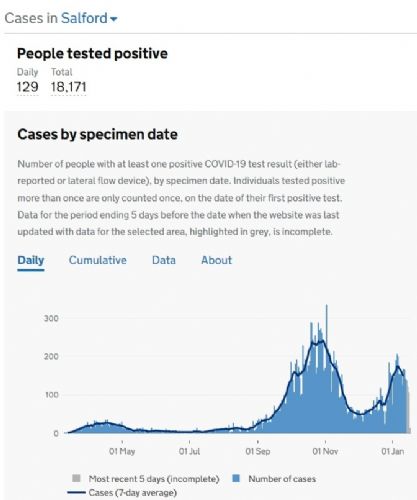
Salford has 129 new coronavirus cases, up from the previous day's 127, bringing the cumulative total to 18,171. The seven day average of cases has decreased to 1,062, down from 1,120, while the seven day rate per 100,000 population now stands at 410.3, down from 432.7.
Elsewhere in Greater Manchester, the seven day average of cases in Bury is 807 (down from 837), with a seven day rate per 100,000 population of 422.5 (down from 438.2); Bolton 1,097 (up from 1,092), with a rate of 381.5 (up from 379.8); Manchester 2,475 (down from 2,530), with a rate of 447.7 (down from 457.6); and Oldham 754 (down from 781), with a rate of 318 (down from 329.4).
Rochdale has a seven day average of cases of 803 (down from 830), with a seven day rate of 361 (down from 373.2); Stockport 1,185 (up from 1,181), with a rate of 403.9 (up from 402.5); Tameside 845 (down from 853), with a rate of 373.1 (down from 376.6); Trafford 1,018 (same), with a rate of 428.9 (same); and Wigan 1,381 (down from 1,415), with a rate of 420.2 (down from 430.5).
There has been one new virus-related death at Salford Royal Hospital.
Meanwhile, staff at Salford Royal Hospital have administered 10,625 doses of vaccines (to NHS staff, care home staff, to patients over 75 and to other health staff), while 8,655 doses of vaccines have been given across the centres at Clarendon, Irlam and Eccles.
A new survey of 10,000 NHS staff by trade union, UNISON, reveals, unsurprisingly, that they feel deeply dissatisfied with their treatment, with only one in ten (10%) saying the Government values NHS staff, and more than four out in five (85%) saying they are angry at how NHS staff are being treated by ministers.
Almost two thirds (64%) said the Government's approach to NHS pay – ignoring calls for an early and significant pay rise in recognition of the difficulties staff have faced in the past year – makes them question their future in the health service.
Many staff are at breaking point, states UNISON, often working long back-to-back shifts to deal with worsening staff shortages and packed hospitals as infections soar. Nine in ten of those surveyed (91%) say a £2,000 pay increase would be a morale boost, while 95% say it would make a "meaningful difference".
According to the survey, a pay rise awarded now would reassure many that their efforts are being recognised. More than four fifths (83%) say it would make them feel confident to continue working in the NHS, and another poll published by UNISON shows a majority of the public (53%) think the Government should bring forward a wage increase for all NHS staff.
.
"Time and again ministers remind the public about protecting the NHS" says UNISON head of health Sara Gorton "The Government can show how to do just that by investing properly in the staff looking after us all. Many are beyond exhausted and feel let down by politicians who expect health workers to give everything but show them little in return.
"A rise of £2,000 as soon as possible would persuade many NHS staff to stay and encourage others to consider a career in health" she adds "The Prime Minister should speed up the pay process to give vital NHS staff what they deserve quickly. Extra money in their pockets will mean more spending in local economies, giving a huge boost to the recovery when the lockdown begins to ease."




.jpg)


.jpg)
.jpg)
(3).jpeg)
.png)
(1).JPG)
