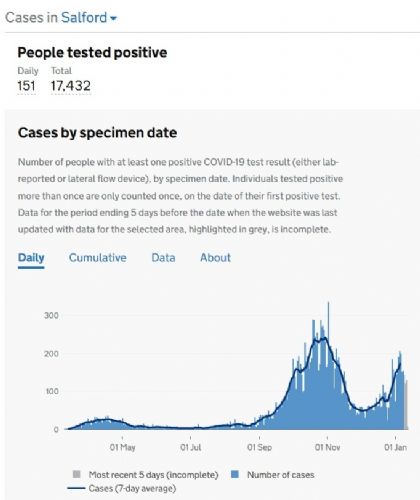
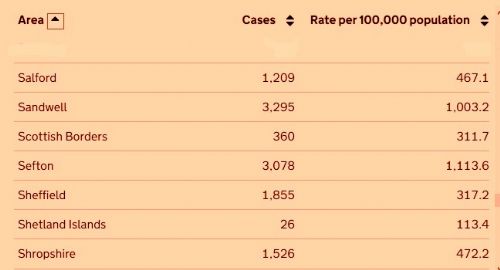
Salford has 151 new coronavirus cases, down from the previous day's 159, bringing the cumulative total to 17,432.. The seven day average of cases has increased to 1,209, up from 1,126, while the seven day rate per 100,000 population now stands at 467.1, up from 435.
Elsewhere in Greater Manchester, the seven day average of cases in Bury is 909 (up from 848), with a seven day rate per 100,000 population of 475.9 (up from 444); Bolton 1,116 (up from 1,061), with a rate of 388.1 (up from 369); Manchester 2,712 (up from 2,532), with a rate of 490.5 (up from 458); and Oldham 914 (up from 867), with a rate of 385.5 (up from 365.7).
Rochdale has a seven day average of cases of 996 (up from 947), with a seven day rate of 447.8 (up from 425.8); Stockport 1,279 (up from 1,212), with a rate of 435.9 (up from 413.1); Tameside 877 (up from 832), with a rate of 387.2 (up from 367.3); Trafford 1,170 (up from 1,084), with a rate of 492.9 (up from 456.7); and Wigan 1,614 (up from 1,533), with a rate of 491.1 (up from 466.4).
There have been two new virus-related deaths at Salford Royal Hospital.
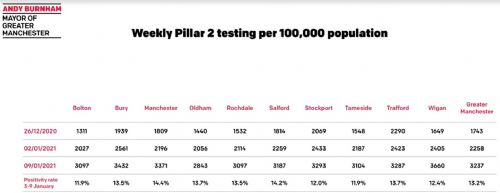
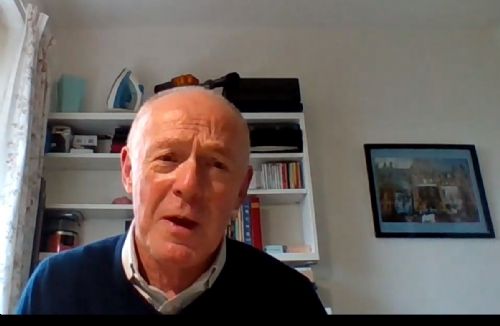
GM Health Lead, Richard Leese, showed slides at yesterday's GM Leaders' press conference showing a big increase in seven day positive virus cases per 100,000 population in Greater Manchester since last week – up from 321.8 on 1st January, to 449.1 on 8th January (Salford: 299 up to 465.5)..."The view is that it's still increasing, although the rate of growth might have slowed down" he said, adding that Greater Manchester was still "way behind" the national average of 630.
That said, however, cases in Greater Manchester have increased by 40% over the last two weeks, while other parts of the country are seeing much smaller increases (see graphic)
Although most cases are still in the younger age groups, 16 to 44, the biggest group in hospital is now the 50 to 75 year olds, Leese explained, while infections in care homes have remained stable at 1.9% of residents showing symptoms of COVID-19, or with positive tests (see graphic).
Meanwhile, people being admitted to hospitals in Greater Manchester with COVID-19 have increased from 124 on 4th January, to 204 on 11th January, while in-patient diagnosis has increased from 472 to 615 over the same period.
The number of COVID-19 patients in critical care beds (ICU) has also increased, from 119 on 5th January, to 147 on 13th January, while the number of COVID-19 patients in non-critical beds has increased from 922 on 5th January, to 1,072 on 12th January. COVID-19 patients now make up the majority of people occupying intensive care beds...
"We are now beginning to see delays in priority operations as the inevitable consequence of this" Leese revealed, explaining that staffing and beds was an issue... "I talked a week ago about the risk of our hospitals falling over; they're not falling over at the moment but clearly the pressures on hospitals are growing all the time, both in critical care and in general and acute beds.
"We haven't reached the peak yet" he said, adding that the affects of New Year's Eve will not feed through for another week "but it's not going to be a peak where we go over the top and come down; it is more likely to be a plateau...at the moment the position is continuing to deteriorate...We're not far from the worst case scenario..."
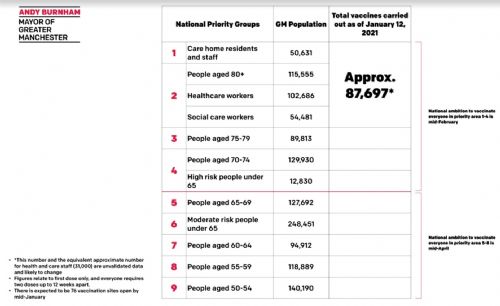
While there is a concern about vaccine supply problems, the roll out of vaccinations is expected to accelerate in the next weeks. Up until 12th January, 87,697 vaccinations have been given in Greater Manchester, although over half a million need to be given to hit the target of vaccinating the top four priority groups by mid-February.
Greater Manchester Mayor, Andy Burnham, argued that people should be wary of a 'growing narrative' that the increasing COVID-19 cases are all the public's fault... "Clearly the gatherings and the reports that GMP are dealing with do have an impact...and it's important to ask people again to comply with the rules...but 8% of people saying that they have a concern about their workplace suggests that it is a significant issue" he said*
"...There are more underlying reasons that need to be looked at and given significant focus, rather than all of the emphasis on individual members of the public who may not be following the rules" Burnham argued, with Leese adding that "The biggest source of transmission does seem to be supermarkets..."
Andy Burnham concluded that "This is a very challenging moment in this whole journey but...people can see the solution taking shape with regards to a vaccination programme that is really taking shape in Greater Manchester."
* For full details see previous Salford Star report on the press conference - click here


.jpg)
.jpg)
.jpg)
.jpg)
.jpg)


.jpg)


.jpg)
.jpg)
(3).jpeg)
.png)
(1).JPG)
