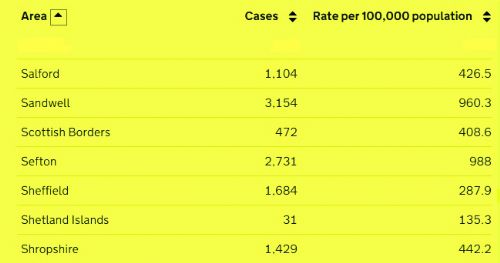
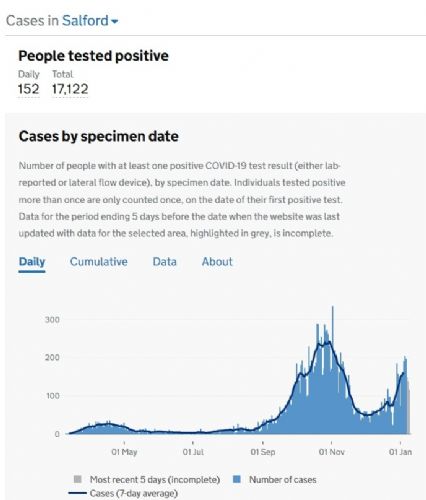
Salford has 152 new coronavirus cases, down from the previous day's 191, bringing the cumulative total to 17,122. The seven day average of cases has increased to 1,104, up from 1,063, while the seven day rate per 100,000 population now stands at 426.5, up from 410.7.
Elsewhere in Greater Manchester, the seven day average of cases in Bury is 832 (up from 827), with a seven day rate per 100,000 population of 435.6 (up from 433); Bolton 993 (down from 1,016), with a rate of 345.3 (down from 353.3); Manchester 2,472 (up from 2,432), with a rate of 447.1 (up from 439.9); and Oldham 881 (down from 914), with a rate of 371.6 (down from 385.5).
Rochdale has a seven day average of cases of 924 (up from 903), with a seven day rate of 415.4 (up from 406); Stockport 1,229 (down from 1,261), with a rate of 418.8 (down from 429.8); Tameside 828 (down from 830), with a rate of 365.6 (down from 366.5); Trafford 1,045 (down from 1,082), with a rate of 440.3 (down from 455.9); and Wigan 1,505 (down from 1,522), with a rate of 457.9 (down from 463.1).
There have been no new virus-related deaths at Salford Royal Hospital.
Vaccinations for Salford people have begun in earnest, with 4,200 doses having been given through the primary care network, mostly to the over 80s, and 7,455 doses via Salford Royal Hospital to care workers and over 80 year olds.
Meanwhile, NHS England has instructed Salford CCG to cancel 924 second vaccine dose Pfizer appointments, even though the batch expires on Wednesday. Salford and Eccles MP, Rebecca Long Bailey raised a question about this in the House of Commons, asking the Minister to allow local Clinical Commissioning Groups to "plan and order their own vaccine batches".
The Minister, Nadhim Zahawi, apologised "to the people of Salford for that cancellation", arguing that there was "lumpiness" in the system but underlined that leaving twelve weeks between doses was "the right thing to do".
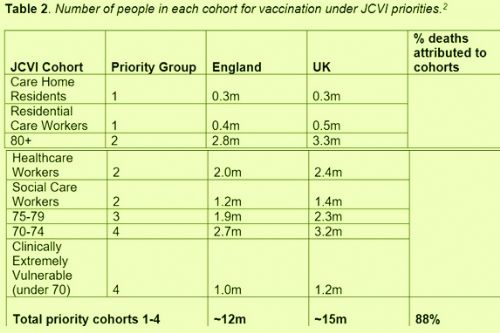
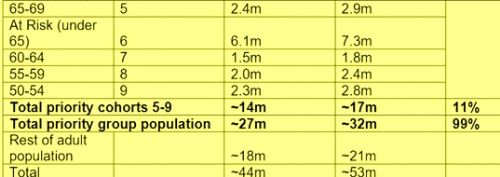
The Government has now published a table of priority vaccinations for people. After the top cohorts of people aged over 80 plus care home and residential care workers, come health care and social care workers and those aged 75-79, then 70-74 year olds and those classed as clinically extremely vulnerable aged under 70. These amount to around 15million people in the UK (88% of all COVID-19 deaths).
After these come 65-69 year olds, anybody at risk who is under 65, then those aged 60-64, 55-59 and 50-54. These amount to around 17million people in the UK. The rest of the adult population, around 21million people in the UK, will follow after these – see graphics for full information
Meanwhile, Salford is rolling out lateral flow tests to asymptomatic workers in retail, transport, construction, trades (plumbers etc), carers, nursery workers and frontline public sector employees. For details – click here




.jpg)


.jpg)
.jpg)
(3).jpeg)
.png)
(1).JPG)
