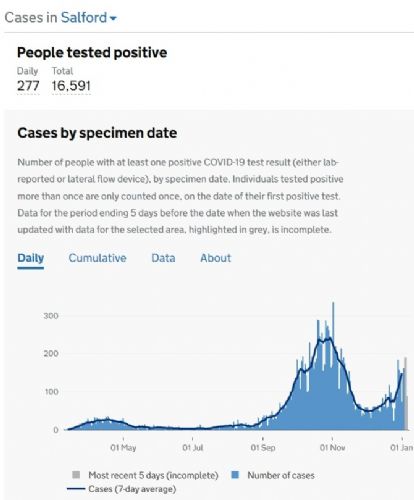
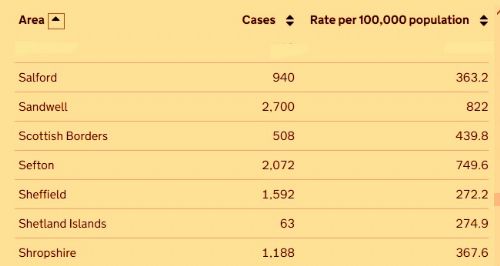
Salford has 277 new coronavirus cases, up from the previous day's 154, bringing the cumulative total to 16,591. The seven day average of cases has increased to 940, up from 862, while the seven day rate per 100,000 population now stands at 363.2, up from 333.
Elsewhere in Greater Manchester, the seven day average of cases in Bury is 775 (up from 743), with a seven day rate per 100,000 population of 405.8 (up from 389); Bolton 880 (up from 808), with a rate of 306 (up from 281); Manchester 2,142 (up from 1,974), with a rate of 387.4 (up from 357.1); and Oldham 795 (up from 743), with a rate of 335.3 (up from 313.4).
Rochdale has a seven day average of cases of 800 (up from 753), with a seven day rate of 359.7 (up from 338.6); Stockport 1,169 (up from 1,121), with a rate of 398.4 (up from 382); Tameside 747 (up from 708), with a rate of 329.8 (up from 312.6); Trafford 1,009 (up from 957), with a rate of 425.1 (up from 403.2); and Wigan 1,399 (up from 1,331), with a rate of 425.7 (up from 405).
There has been one new virus-related death at Salford Royal Hospital.
Meanwhile, after the most recent Office for National Statistics survey revealed that 1 in every 27 secondary-age children and 1 in 40 primary-age children are infected, the National Education Union, or NEU, has again slated the Government, calling the figures "truly shocking and entirely the result of Government negligence"...
"The fact that the Government has consistently downplayed the risk of large groups gathering in schools without social distancing in poorly ventilated buildings and with minimal mask wearing has undoubtedly contributed to the dire situation the country is currently in" explained Dr Mary Bousted, Joint General Secretary of the NEU.
"This week the Government has been caught widening the definition of key worker and vulnerable children, largely due to their past failures to set up adequate contingency plans in the first place" she added
"If the Government is serious about having more children at school during this lockdown it should reduce bubbles and groups sizes to minimise transmission risks" she concluded "However, with current staff already fully engaged in providing remote learning to the children at home, reducing bubble sizes will require more staff. The Government should demonstrate its commitment to our young people by mobilising supply staff, many of them currently furloughed or even without pay, for this task."
The Government's widening of the term 'vulnerable children' is already having repercussions in Salford, where, in Broughton, a huge row has broken out between the Council and 'outraged' residents over orthodox Jewish schools, including Kerem Shloime School, which have remained open for large numbers of pupils.
In response to residents' concerns, John Merry, Deputy City Mayor and Lead Member for Children's and Young People's Services, reiterated Government advice...
"The guidance is leading to many pupils being eligible to attend schools across our city" he wrote "Under the rules of the current lockdown, vulnerable pupils and the children of key workers can continue to attend school. The guidance stresses that it is 'important that on-site provision is provided for these pupils'.
"There is also 'no limit to numbers of these pupils who may attend and schools should not limit attendance of these groups. This is because we are reducing overall social contact across areas and the country rather than individually by each institution'" Merry quoted
"The definition of vulnerable children and young people 'includes children who have a social worker, an education, health and care plan (EHCP) or who may be vulnerable for another reason at local discretion'" he added "The DfE has also said that some pupils who have difficulty engaging in remote education 'may be considered to be vulnerable children, and therefore eligible to attend provision in person'. This was added to the criteria for vulnerable children in September, however has led to some schools saying much more children are attending than in the March lockdown.
"The DfE guidance states admitting pupils because of remote education concerns is a decision 'based on local discretion and the needs of the child and their family, as well as a wide range of other factors'" he explained "Pupils not having a quiet space at home to learn is one of the criteria which schools can use to identify pupils as vulnerable.
"In view of this it is technically the case that children who do not have access to computers are classified as vulnerable children and hence should attend school" he concluded "I appreciate that this is very frustrating but it is a situation not of our making."
However, the row continues, with police checking shops in the area and finding "some premises that should not be open", although premises that were authorised to open were quite COVID compliant – "some needed advice re social distancing"...
At GM Mayor, Andy Burnham's press conference on Wednesday, the Jewish Telegraph reporter also raised questions about the compliance of the orthodox Jewish community, with one wedding stopped that expected one hundred guests, a funeral attended by three hundred people and non-essential shops remaining open via the 'back door'.
"What is being done to police lockdown restrictions in areas where they have consistently been ignored or broken?" the reporter asked.
"The issues you've raised are serious" Burnham responded "And I'll commit now to working with Bev [Hughes, Police Commissioner] to look into these issues because they are completely out with what should be happening at this moment in time. They are outrageous breaches, if they have gone ahead, of the rules that are now in place and would need to be dealt with quite severely given the numbers you are describing..."
Bev Hughes promised to "redouble efforts to get the message out to the wider community that these activities are just not appropriate at this time".
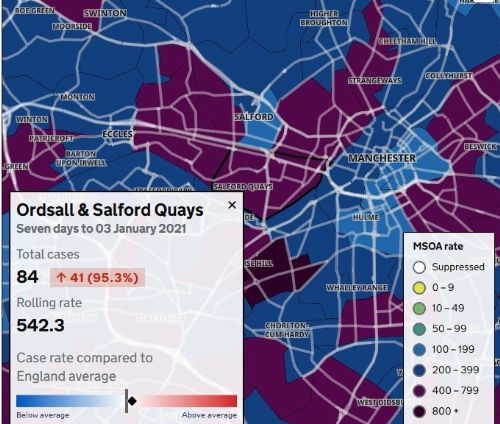
According to the latest Government statistics, in the seven days to 3rd January, virus cases in Higher Broughton and Broughton Park were nowhere near as bad as other areas of Salford.
Higher Broughton had 41 new cases (up 127.8%) with a rolling rate of 261.2, while Broughton Park had 17 cases (down 32%) with a rolling rate of 232.6. This compares with Ordsall and Salford Quays with 84 new cases (up 95.3%), with a rolling rate of 542.3.
Other areas in Salford with very high rates include Langworthy Buile Hill with a rolling rate of 561.7; Weaste and Seedley 430.4; Ellenbrook and Boothstown 433.9; Patricroft 427; Lower Irlam and Cadishead 402.5; Swinton West 435.7 and Lightoaks 484.2.
To view the full interactive map – click here and enter a postcode
Update: 10am
John Merry has been in touch to say that he doesn't agree with the DfE guidance "Through the LGA we have argued for the guidance to be changed. Private schools do not come within the jurisdiction of the Council..."




.jpg)


.jpg)
.jpg)
(3).jpeg)
.png)
(1).JPG)
