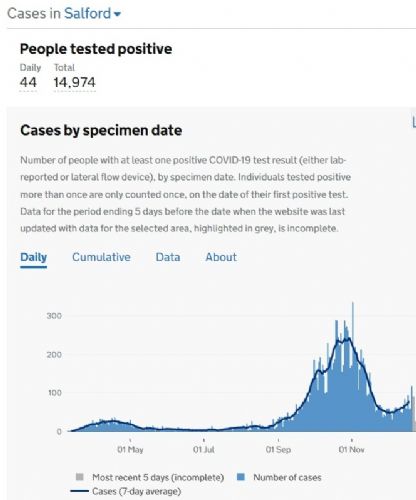
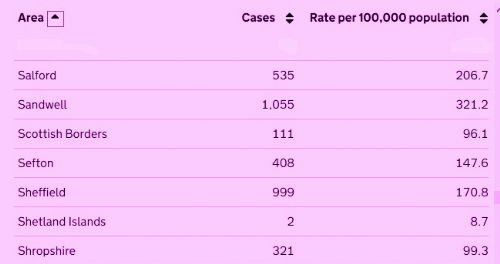
Salford has 44 new coronavirus cases, down from the previous day's 96, bringing the cumulative total to 14,974. The seven day average of cases has increased to 535, up from 486, while the seven day rate per 100,000 population now stands at 206.7, up from187.8.
Elsewhere in Greater Manchester, the seven day average of cases in Bury is 413 (up from 399), with a seven day rate per 100,000 population of 216.2 (up from 208.9); Bolton 442 (up from 449), with a rate of 153.7 (down from 156.1); Manchester 1,113 (up from 1,082), with a rate of 201.3 (up from 195.7); Oldham 464 (down from 482), with a rate of 195.7 (down from 203.3);
Rochdale has a seven day average of cases of 468 (up from 457), with a seven day rate of 210.4 (up from 205.5); Stockport 517 (up from 456), with a rate of 176.2 (up from 155.4); Tameside 338 (up from 316), with a rate of 149.2 (up from 139.5); Trafford 475 (up from 430), with a rate of 200.1 (up from 181.2), and Wigan 536 (up from 504), with a rate of 163.1 (up from 153.3).
There have been no new virus-related deaths announced by Salford Royal Hospital.
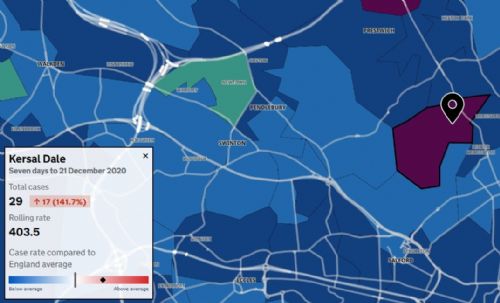
Meanwhile, a new interactive Government map, published yesterday and revealing the seven day rolling rate of cases by specimen date ending 21st December, shows Kersal Dale containing the highest infection rate in the city with a rate of 403.5 (29 new cases), compared to Little Hulton South which has the lowest rate of 56 (4 new cases), Higher Irlam with a rolling rate of 80.5 (8 new cases) and Swinton Newtown with a rolling rate of 82 (5 new cases).
Most Salford Middle Super Output Areas fall within light blue sections (100-199 rates of infection), and darker blue sections (200-399 rates of infection).
To check how an area is doing click here and enter a postcode




.jpg)


.jpg)
.jpg)
(3).jpeg)
.png)
(1).JPG)
