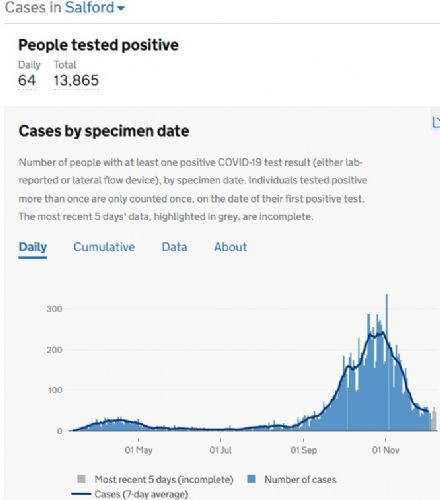
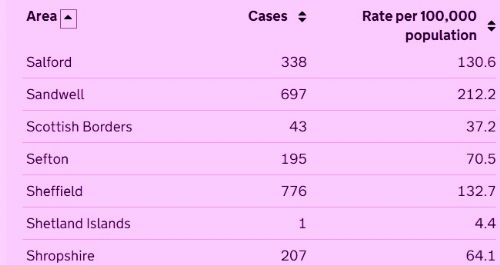
Salford has 64 new coronavirus cases, up from the previous day's 59, bringing the cumulative total to 13,865, as the overall fall in infections levels off. The seven day average of cases has now decreased slightly from 351 to 338, as has the seven day rate per 100,000 population which fell from 135.6 to 130.6.
Elsewhere in Greater Manchester, all boroughs, except Manchester, continue to see a slight drop in seven day totals,
Cases in Manchester during the latest seven day data period were 941 (up from 932), with a rate of 170.2 (up from 168.6), followed by Bolton with 473 (down from 502), with a rate of 164.5 (down from 174.6), and Oldham 367 (down from 379), with a rate of 154.8 (down from 159.8).
Wigan has 615 (down from 625), with a rate of 187.1 (down from 190.2), Tameside 267 (down from 272), with a rate of 117.9 (down from 120.1), Rochdale 479 (down from 493), with a rate of 215.4 (down from 221.7), Stockport 334 (down from 346), with a rate of 113.8 (down from 117.9), Bury 432 (same), with a rate of 226.2 (same), and Trafford 202 (down from 208), with a rate of 85.1 (down from 87.6).
There have been four new virus-related deaths at Salford Royal Hospital.
Greater Manchester has plans in place for safe care home visits, after the lateral flow tests were exposed as picking up only around 50% of cases. Visitors will get a PCR test three days before they visit, and a lateral flow test on the day of the visit.
Meanwhile with the Government deciding which tier Salford and Greater Manchester will be in next week, yesterday the Greater Manchester Leaders explained why they will be making the case for the whole of the region to go into Tier 2.
However they also accepted that Greater Manchester might be split between North and South, with some boroughs, including Salford, Manchester, Stockport and Trafford in Tier 2, while Bury, Rochdale and Oldham remain Tier 3. The Government will review the tiering next Wednesday 16th December, announce its decision on Thursday and implement any changes on Friday 19th.
GM Health Lead, Richard Leese, showed tables to the week ending 4th December that point to a "significant decline" in cases across the whole of Greater Manchester, apart from Bury which has had some specific outbreaks of the infection (see cases table), and downward trends in all age groups, including over 65s (see age heat map).
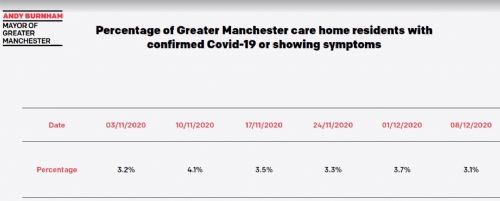
To back this up, Leese explained that out of the first ten thousand students who have been tested there were only thirty positive cases were identified, while the 3.1% of care home residents who have COVID-19 or who have symptoms has fallen to its lowest for a month.
Meanwhile, Salford's positivity rate fell to 5.7% in the week ending 5th December, the joint third lowest in the region, despite an increase in testing.
Meanwhile, hospitals in the region are under less pressure, with weekly admissions and in-patient diagnosis for the virus down from 492 on 30th November to 418 on 7th December. The number of COVID-19 patients in intensive care beds also fell from 116 to 107 during this period, and the number of patients in non-intensive care beds also fell from 919 to 765 (see main graphic table).
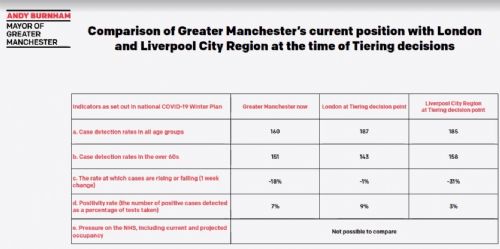
Leese compared the Government's own indicators from when London and Liverpool were put in Tier 2, with Greater Manchester now. Case rates here (160) are now lower than when London (187) and Liverpool (185) entered Tier 2, while case rates in the over 60s (151) are higher than London (143) at the time but lower than Liverpool (158).
Cases have fallen by 18% in Greater Manchester over the past week, compared to London (1%) when it entered Tier 2 and Liverpool (-31%), and our average positivity rate currently shows 7%, compared to 9% when London entered Tier 2 and 3% when Liverpool entered Tier 2.
"You can see very clearly that the Greater Manchester numbers suggest that we are
now in a position to move into Tier 2, and the expectation is that in a week's time the figures will be even better" said Leese "We will be pressing for the whole of Greater Manchester to be in Tier 2...but there are certainly clusters of local authorities within the city region that have almost overwhelming case to be put in Tier 2."
Greater Manchester Mayor Andy Burnham argued that economic factors should also influence the Government's decision next week, as it did with London when it was placed in Tier 2...
"The point needs to be made that if you were to keep a city like Manchester in Tier 3 over the holiday period, it does have the affect if hospitality is closed, of creating an incentive for people to have more informal gatherings in the home, and we keep being told that is the major cause of spread of the virus" he explained "We would ask the Government to take into consideration whether that makes sense..."
From Monday, the vaccination programme in Greater Manchester will be moving to phase two, with more locations coming online and data available soon...


.jpg)
.jpg)
.jpg)
.jpg)
.jpg)


.jpg)


.jpg)
.jpg)
(3).jpeg)
.png)
(1).JPG)
