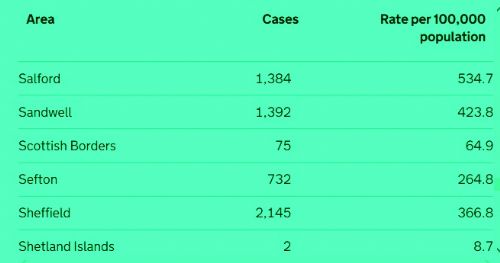
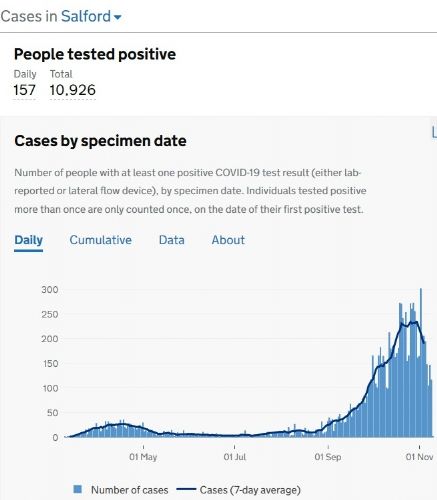
Salford has 157 new confirmed cases of coronavirus, down from the previous day's 160, as the cumulative total rose to 10,926, up from 10,769. The seven day average of cases also decreased from 1,464, to 1,384, together with the seven day rate per 100,000 population which went down again from 565.6 to 534.7.
Cases in Manchester during the latest seven day data period were 2,329 (down from 2,441), with a rate of 421.3 (down from 441.5), followed by Bolton with 1,526 (down from 1,551), with a rate of 530.7 (down from 539.4) and Oldham 1,737 (down from 1,842), with a rate of 732.6 (down from 776.9).
Wigan has 1,906 (down from 1,990), with a rate of 579.9 (down from 605.5), Tameside 1,030 (down from 1,087), with a rate of 454.8 (down from 479.9), Rochdale 1,294 (down from 1,330), with a rate of 581.8 (down from 598), Stockport 1,069 (down from 1,130), with a rate of 364.3 (down from 385.1), Bury 1,084 (down from 1,124), with a rate of 567.6 (down from 588.5), and Trafford 948 (up from 934), with a rate of 399.4 (up from 393.5).
Again, all bar one of the Greater Manchester boroughs had a decline in cases, and GM Mayor Andy Burnham said that the direction was "good news" and "encouraging" at his weekly press conference yesterday.
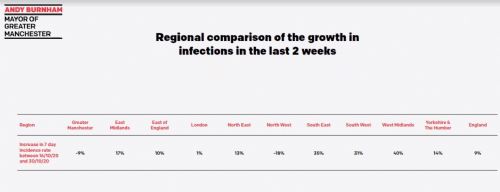
He provided a slide showing that over the two weeks ending 30th October, Greater Manchester saw a negative growth in infections, at -9%, and the North West at -18%...while all other regions in England have seen a rise, with the West Midlands seeing a 40% increase in infections, the South East 35% and the South West 31% (see graphic). However, as Burnham pointed out, Greater Manchester was starting from much higher case rates, and still is.
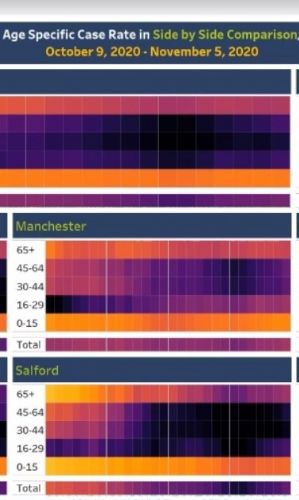
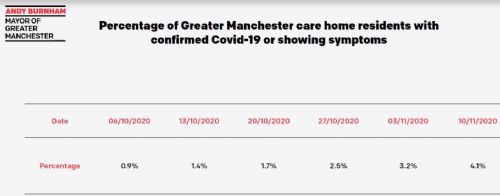
Burnham also showed a 'heat map' of cases by age in each Greater Manchester borough showing falling infections in the over 65s and 45-65 age groups (see graphics), although the percentage of care home residents experiencing symptoms or who have been tested positive has risen to 4.1%, from 3.2% last week, albeit nowhere near spring figures.
Another slide showed Salford's positivity rate at 18.9% down from 19.2%, although there was a reduction in tests being carried out in the week of 7th November. Burnham speculated that fewer tests could be because less people are experiencing symptoms as there are no current problems with accessibility to tests.
Meanwhile, for the whole of Greater Manchester, COVID-19 admissions to hospitals are falling (from 131 on 2nd November, to 98 on 9th November), together with in-patients diagnosed with COVID-19 (from 779 to 755).
However there is a slight increase in patients in intensive (ICU) beds (from 126 on 3rd November to 129 on 9th November) and a much larger increase in those in non-ICU beds, from 1,049 on 3rd November, to 1,208 on 9th November. New Government figures show that on 3rd November, Salford Royal Hospital had 133 COVID-19 patients, the highest number since the second wave.
"It suggests that hospitals are experiencing quite a lot of pressure and finding it harder to discharge patients which may explain some of the recent pressure on the ambulance service" Burnham explained.
"Although there are signs, perhaps, that we may have seen the peak of the second wave with regard to the number of new infections in the community, it's important for me to say that it doesn't yet appear that we've reached the peak in terms of pressure on our hospitals" he added "And that is more likely to be felt during the later part of this month...from an NHS point of view we haven't seen the full impact yet of the second wave."
Meanwhile Salford Royal Hospital has announced a further seven virus-related deaths.


.jpg)
.jpg)
.jpg)

.jpg)


.jpg)


.jpg)
.jpg)
(3).jpeg)
.png)
(1).JPG)
