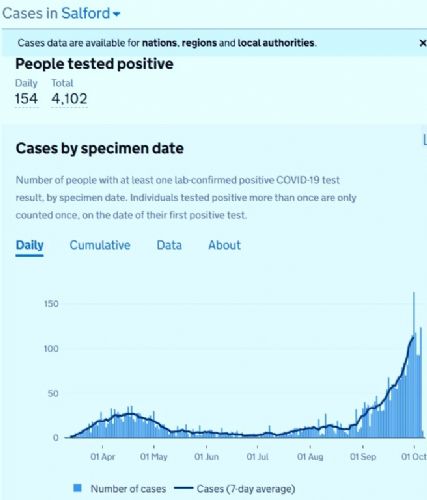
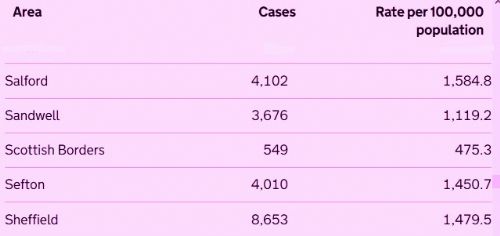
Salford has 154 new confirmed cases of coronavirus, bringing the cumulative total to 4,102, up from the previous day's 3,948.
Elsewhere in Greater Manchester, cases in Manchester rose to 11,157 (up from 10,794), followed by Bolton 5,736 (up from 5,612), Oldham with 5,075 (up from 4,938), Wigan 4,510 (up from 4,372), Rochdale 4,267 (up from 4,123), Tameside 3,720 (up from 3,605), Stockport 3,535 (up from 3,401), Trafford 3,128 (up from 3,007) and Bury 3,338 (up from 3,226).
There have been no new virus-related deaths at Salford Royal Hospital. What is going on in Greater Manchester with the increased cases, few deaths and lower than expected hospital admissions was discussed in depth at yesterday's Greater Manchester Leaders' press conference. A full report will follow...(click here)
Meanwhile, the NHS has announced more support for long COVID sufferers, those who have recovered from the disease but still feel the fall-out which includes chronic fatigue, 'brain fog', anxiety and stress. It is estimated that ten per cent of COVID patients could be experiencing symptoms more than three weeks after infection, and that 60,000 people could be suffering after more than three months.
The NHS is to offer specialist help at clinics in every area, including Salford, to complement existing primary, community and rehabilitation care. Services will include - a physical assessment, which will include diagnostic testing, to identify any potential chronic health issues; a cognitive assessment, to assess any potential memory, attention, and concentration problems; and a psychological assessment, to see if someone is suffering potentially from depression, anxiety, PTSD, or another mental health condition.
There is already an online Your Covid Recovery rehab service which provides personalised support to patients, used by over 100,000 people, and this is also to be enhanced
"While this is still a relatively new virus, we are learning more about COVID with every passing week" says NHS Chief Executive Simon Stevens "It is now clear that long COVID can have a major impact on the lives of a significant minority of patients weeks or months after they have contracted the virus. So, just as the NHS quickly put in place specialist hospital care for acutely ill COVID patients at the start of the pandemic, now we must respond sensitively and effectively to these new patient needs."




.jpg)


.jpg)
.jpg)
(3).jpeg)
.png)
(1).JPG)
