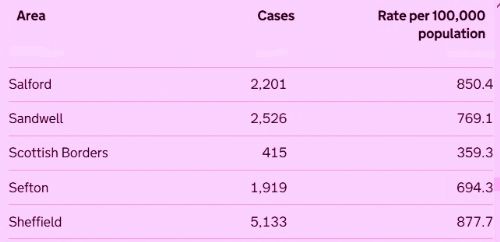
Salford has 27 new confirmed cases of coronavirus, bringing the cumulative total to 2,201, up from the previous day's 2,174.
Elsewhere in Greater Manchester, cases in Manchester rose to 5,053 (up from 4,983), followed by Oldham with 3,327 (up from 3,281), Bolton 3,302 (up from 3,239), Rochdale 2,575 (up from 2,544), Wigan 2,564 (up from 2,534), Tameside 2,323 (up from 2,274), Stockport 2,191 (up from 2,163), Trafford 1,867 (up from 1,851) and Bury 1,852 (up from 1,826).
There have been no new virus-related deaths announced by Salford Royal Hospital.
Meanwhile, new research led by the University of Salford*, released this morning, shows that coronavirus benefit claimants are more likely to be younger, middle class, or more likely to be BAME.
The analysis shows that, since March 2020, the socio-demographic profile of new claimants differs considerably from those who were claiming benefits before the outbreak. The findings show that new benefit claimants are...
• Younger: almost half (46%) of new benefit claimants are aged between 18-39 years old, compared to 37% of existing claimants.
• BAME: 8% of new claimants are from BAME backgrounds compared to 6% of existing claimants.
• Men: 49% of new benefit claimants are male compared to 43% of existing benefit claimants.
• Not experiencing a disability: only 38% of new benefit claimants have a health condition or disability, compared to 67% of existing claimants.
• From a higher 'social grade': 'social grade' is a classification system commonly used in market research, which looks at employment status and the sort of jobs people do. More than a quarter (26%) of new claimants are from social grade AB (managerial, administrative and professional occupations) compared to 15% of existing claimants.
• University graduates: almost a third (32%) of new claimants had a university diploma or above, compared to 26% of existing claimants.
• Homeowners: 29% of new benefit claimants were owner occupiers compared to 25% of existing claimants. In addition, only 13% of new claimants were social renters compared to 33% of existing claimants.
"Examining our survey data alongside administrative records, we have been able to establish whether there is something genuinely distinctive about the new COVID-19 cohort of benefit claimants" states Salford Uni's Dr Daniel Edmiston, who led the report "Where administrative records are not publicly available, our survey data provides a unique opportunity to evidence changes in the demographic profile of benefit claimants. Our findings underline the need for social assistance and employment support that is better tailored to this diverse new cohort of benefit claimants."
Professor Lisa Scullion, who also led the project, adds: "We're delighted that this project is already meeting our aim of providing rapid large-scale evidence for policy makers on the challenges facing our welfare benefits system. It is vital that we understand how people are managing to navigate the benefits system, and what support they may need in order to do so.
"Understanding who is claiming benefits is key to this" she explains "We do not know whether the current cohort of benefit claimants will be the same as forthcoming waves of claimants as the full effects of COVID-19 are felt: the reasons motivating new claims will be subject to the distinctive phases of economic crisis surrounding the pandemic. However, these phases can and should be anticipated to ensure support services are in place for the increased and changed demand on the benefits system that is likely on the horizon."
*The report comes from the Welfare at a (Social) Distance project; a major national research project investigating the benefits system during Covid-19 and its aftermath. The project is led by the Sustainable Housing and Urban Studies Unit (SHUSU) at the University of Salford, working in collaboration with the University of Kent, the University of Leeds, the LSE and Deakin University, Australia. This study draws on survey data collected online from 7,601 new and existing claimants by YouGov between 21st May and 15th June 2020.






.jpg)


.jpg)
.jpg)
(3).jpeg)
.png)
(1).JPG)
