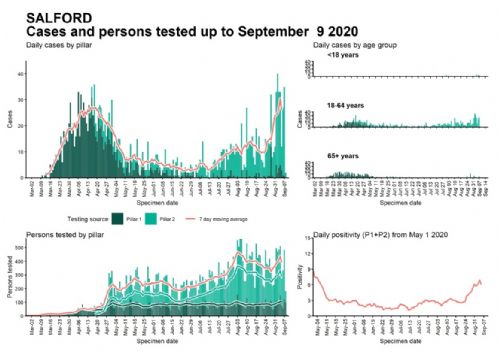
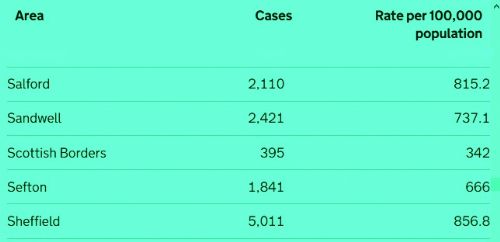
Salford has 38 new confirmed cases of coronavirus, bringing the cumulative total to 2,110, up from the previous day's 2,072.
Elsewhere in Greater Manchester, cases in Manchester rose to 4,852 (up from 4,784), followed by Oldham with 3,199 (up from 3,155), Bolton 3,047 (up from 2,936), Rochdale 2,492 (up from 2,463), Wigan 2,488 (up from 2,461), Tameside 2,208 (up from 2,164), Stockport 2,114 (up from 2,097), Trafford 1,823 (up from 1,809) and Bury 1,779 (up from 1,747).
There have been no new virus-related deaths at Salford Royal Hospital.
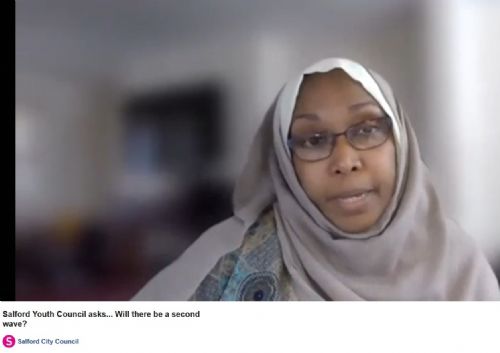
Meanwhile, in a video meeting with Salford Youth Council, the city's Director of Public Health, Dr Muna Abdel-Aziz, responding to a question about a second wave of the virus in the city said "We think we're on the foothills of a second wave. The question is whether that second wave will be massive and overwhelming in the way that we saw the first wave which meant that we all had to lock down, or will the virus this time circulate amongst a different group of people and we can still manage to keep our workplaces and settings open. So that's the question.
"...Yes, a second wave is coming" she explained "Are we already in the beginning of it? I think we may already be in the beginning of it. But it may not be as devastating or as scary as people worry about if everyone follows the basic rules. If not, the second wave will be devastating."
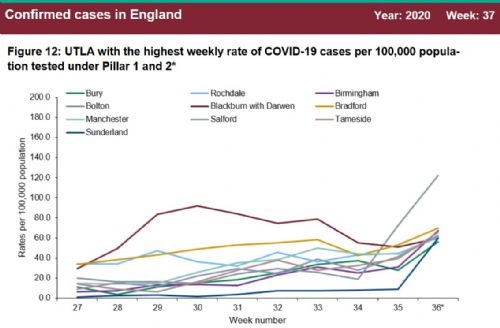
Yesterday, Public Health England released its latest weekly surveillance report based on data from between 31st August and 6th September, which put Salford as fourth worst virus area in the country, with a weekly rate of 62.9 cases per 100,000 population. In the days since then, Salford's rate has mushroomed to 83.7.
Top of the Watchlist areas was Bolton with a rate of 121.9, followed by Bradford with 72.2 and Oldham with 66.6.
Public Health England also published a map of Salford COVID-19 rates by Lower Super Output Areas, comparing the 14 day period from 13th-26th August, with the 14 day period 27th August to 9th September which shows the spread of the virus to lots more areas in the city (see graphic).
Main graphic shows rate of COVID-19 with Salford coloured darkest red


.jpg)
.jpg)
.jpg)


.jpg)


.jpg)
.jpg)
(3).jpeg)
.png)
(1).JPG)
