"Certainly within this country the chances of eradicating it through the sorts of measures we have been taking, I think, are virtually nil..." Richard Leese
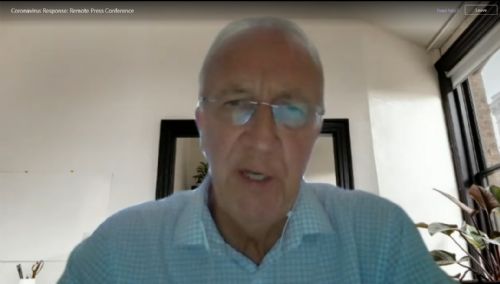
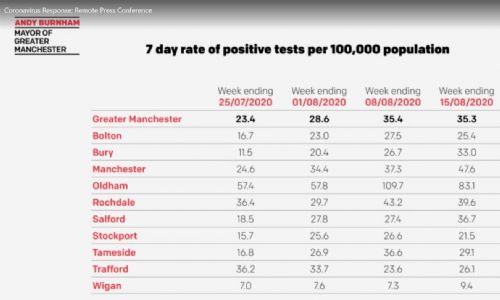
At this afternoon's coronavirus centred press conference, GM Health Lead, Richard Leese, produced statistics on the seven day rate of positive tests per 100,000 population which showed that the Greater Manchester average was almost stable - going from 35.4 in the week ending 8th August, to 35.3 in the week ending 15th August.
Half of the ten boroughs of Greater Manchester saw the rate go down, while the other half saw the rate go up, including Salford which rose from 27.4 to 36.7 (see table). Salford is the 'amber' category, with only Oldham in the 'red' category and Stockport and Wigan in the 'green' category.
Leese underlined the 'evidence led' approach in Greater Manchester, and "as the evidence changes, clearly we will change our response" he said, adding a battery of information showing the "radical change in the way that COVID-19 is impacting on the whole of Greater Manchester"...
Seven day averages for hospital admissions have halved over last week from 3.6 to 1.3; with just 14 people in intensive care (ICU) with COVID-19 symptoms and non-ICU cases down from 71 cases in hospital to 50 cases across Greater Manchester...Plus, in the last seven days there have been 15 deaths recorded as coming from COVID-19, compared to 237 deaths in the week of 30th April...
"People who are testing positive generally have low or no symptoms; they are not contacting their GP, they're not dialling 111 and they are not going to hospital" Leese added "The age range is still almost entirely under 60...the Manchester increase is predominantly in the 20-30 age range. It's a younger age group and we don't know whether the virus has changed or not but the impact has changed over time."
He explained the virus is still 'pandemic', "so we still need to be taking action to bring the virus under control and there is still a risk around vulnerable people and shielded people, that if they did come into contact with the virus it would have a significant impact on them; and, coupled with what might happen in winter, that is an ongoing risk.
"At the same time" he added "It's becoming more and more clear that some of the measures and restrictions the Government has imposed are now almost certainly causing more damage than they are saving lives. We have seen over recent weeks a significant increase of people with mental health issues presenting...and the economic situation continues to deteriorate...
"In general we would not support any increase in the restrictions that are in place...some of the restrictions, for example casinos and beauty businesses not operating, are now damaging rather than helping" he argued "Certainly the ability to meet in open spaces is something that is not helping either."
However, he added that measures like not visiting people in their home, continuing to wear masks and continuing social distancing in bars, restaurants and shops are still making a difference.
Finally, Leese explained that last week more people died in Manchester from smoking than COVID-19, although that wasn't to "underestimate the potential impact of what is still a pandemic but it is to make the case to Government that the way we deal with that pandemic has got to be evidence based and proportionate".
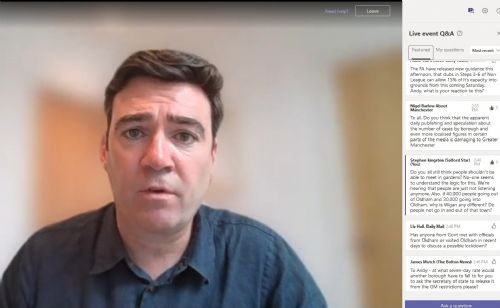
GM Mayor, Andy Burnham, also emphasised the "changed picture" with "cautious optimism that the increases have levelled out", even though the case numbers remain high in a number of boroughs.
Oldham Council Leader, Sean Fielding, put forward the case for no local lockdown in Oldham, arguing that there's been a decrease in case numbers there over the last week, that cases are now centred around the working age population with household spread dominating via people working in low paid occupations, crowded living conditions and multi-generational families living in those crowded conditions.
"It has not been brought back to those households by people going out for a pint, or going out for something to eat or going out to buy a t-shirt in the businesses that have re-opened after the lockdown" he said "It's because people in those households tend to do the kind of employment that never really shut down in the first lockdown...the kind of employment that brings you into contact with the public quite a lot; public transport workers, taxi drivers, takeout delivery drivers, people who work in essential retail...That is the source of the virus getting into homes and spreading within homes...Closing down non-essential businesses in Oldham would not change that. It would not solve that problem."
He concluded that a local lockdown in Oldham wouldn't just be a "disaster" but wouldn't work because there are 40,000 people going out of Oldham every day and 30,000 going into Oldham.
Meanwhile, Wigan Council Leader, David Molyneux, argued that all Greater Manchester restrictions imposed in Wigan should be lifted, given the low rates of positive tests and case numbers.
Andy Burnham said that he would be writing to the Health Secretary today setting out the Greater Manchester position, that a local lockdown in Oldham would be "highly problematic"; and that the measures in place had "begun to work".
The Greater Manchester leaders want to see the current measures remain in place in the ten boroughs with the exception of Wigan, although they do want to see businesses - like ice rinks, casinos and beauty parlours - that had delayed re-openings, to be allowed to trade like in the rest of the country, although Oldham should not be included in that.
Burnham made it clear that the final decision lies with the Government tomorrow and that he "hopes the Government listens..."
Richard Leese underlined that, although "the nature of the problem has changed there is still a problem and we need to do what we can to reduce the level of the problem...
"Our view is that at the moment the balance isn't right, and far from increase the number of restrictions, reduce the level of restrictions to those things that really make a difference" he added "...Most of the transmission is now in people's homes, so stopping people going to work and stopping people mixing in a safe environment is not going to reduce that risk at all...We now know more than we did three weeks ago and have to act accordingly."
In answer to a question from the Salford Star about the illogical decision that people cannot meet in gardens, Andy Burnham responded that the Greater Manchester leaders also believed it was illogical...
"Obviously the Government didn't go with that but we still think there is a case for easing the restrictions generally on people in gardens because obviously there can't really be any evidence that says you can't talk to somebody in your garden but you can in a park" he said "We've always said that we have a difficulty with that and that is one of the things that has caused some frustration with the public."
Richard Leese added that "It's impossible to explain to anybody, and if you can't give a rational reason for something people aren't going to do it are they?"
In response to another media question, Leese concluded that while there is no current vaccine for COVID and no cure, it is likely to continue and at some point "have a particular rate that we are simply going to have to accept...Certainly within this country the chances of eradicating it through the sorts of measures we have been taking, I think, are virtually nil..."
Andy Burnham concluded by saying that as the rates for each borough in Greater Manchester come down, the leaders will look at easing restrictions...


.jpg)


.jpg)


.jpg)
.jpg)
(3).jpeg)
.png)
(1).JPG)
