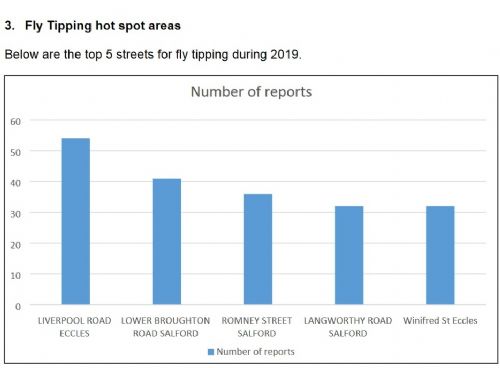
A new report by Salford City Council reveals the top five streets in the city for fly tipping during 2019...
And the winner is...Liverpool Road in Eccles, with 54 reports of fly tipping. Runner up was Lower Broughton Road with 41 reports, followed by Romney Street in Charlestown with 38 reports, Langworthy Road with 32 reports and Winifred Street in Eccles also with 32 reports.
Salford saw around a 2% increase in fly tipping last year, from 5,990 incidents in 2018, compared to 6,104 in 2019.
The Council report gives all sorts of waste and recycling statistics – like Salford spends £18.80 per household annually on street cleaning, one of the lowest spends in Greater Manchester, where the highest cost is £72.83 per household and the lowest is £18.75 per household.
There were also 20,490 missed bin collections in 2019, slightly up from 20,340 the previous year. In relation to the 13,134,880 total collections for the city, the figure represents 0.1554% - and many of these missed bins could be the result of roadworks, contamination or people failing to put their bins out but reporting them as 'missed', the report points out.
There were 39 fixed penalty notices issued last year for dumping (32 in 2018), nine fly tipping prosecutions (15 in 2018), and 1,408 litter-related fixed penalty notices issued, of which 962 were paid.
Despite all the publicity – and £60,000 is again being spent on recycling and waste marketing and communication this year – Salford is the third worst area in Greater Manchester for recycling, with a rate of 45.58%. The highest recycling rate is in Trafford with 58.53%, and the lowest is in Manchester with 38.56%.
On the positive side, although it's hard to work out what it means, Salford is boasting the 'greatest waste capacity in Greater Manchester' with 560 litres per week.
In the recent budget, an extra £585,000 was earmarked for waste in 2020-21, with £306,680 going on clearing fly tipping and alley ways, £184,700 being spent on four 'Behaviour Change Officers', £13,440 being spent on CCTV in fly tipping hot spot areas, £20,000 on digital street litter bins which alert the Council when full, and that £60,000 on waste and recycling marketing.
The Behaviour Change Officers would help to 'increase recycling participation, reduce contamination and present greater opportunities for enforcement' the report states.
By the end of all this, Salford residents should have the most spotless back allies in Greater Manchester...




.jpg)


.jpg)
.jpg)
(3).jpeg)
.png)
(1).JPG)
