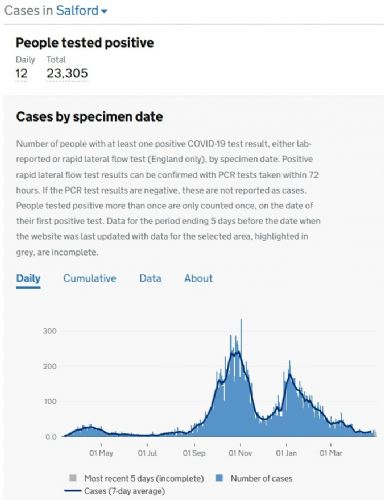
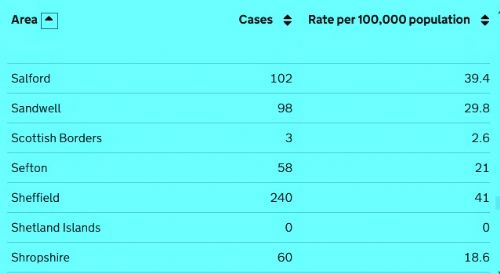
Salford has 12 new coronavirus cases, down from the previous day's 14, bringing the cumulative total of cases to 23,305. The seven day average of cases in Salford is now 102, up from 96, while the seven day rate per 100,000 population now stands at 39.4, up from 37.1.
Elsewhere in Greater Manchester, the seven day average of cases in Bury is 45 (up from 43), with a seven day rate per 100,000 population of 23.6 (up from 22.5); Bolton 143 (up from 136), with a rate of 49.7 (up from 47.3); Manchester 203 (down from 216), with a rate of 36.7 (down from 39.1); and Oldham 85 (down from 91), with a rate of 35.8 (down from 38.4).
Rochdale has a seven day average of cases of 72 (up from 66), with a seven day rate of 32.4 (up from 29.7); Stockport 68 (down from 76), with a rate of 23.2 (down from 25.9); Tameside 77 (up from 69), with a rate of 34 (up from 30.5); Trafford 97 (up from 94), with a rate of 40.9 (up from 39.6); and Wigan 73 (up from 69), with a rate of 22.2 (up from 21).
There have been no new virus-related deaths announced by Salford Royal Hospital.
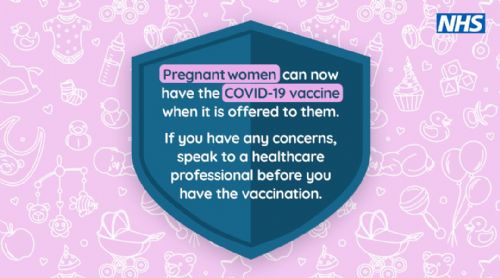
The NHS states that pregnant women should now have the vaccine when it is offered to them.
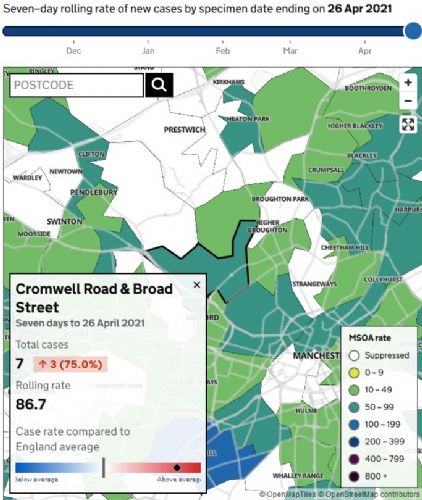
Meanwhile, while the rates of infection in Salford remain low, the new interactive map from the Government for seven day rolling rates of infection per 100,000 population in the week ending 26th April shows that some areas are above the city's average and way above the England average.
Cromwell Road and Broad Street has a rolling rate of 86.7 (7 new cases)
Clifton has a rolling rate of 84.3 (5 new cases)
Salford Central and University has a rate of 79.3 (12 new cases)
Walkden South has a rate of 63.2 (6 new cases)
Patricroft has a rate of 58.9 (4 new cases)
Little Hulton South has a rate of 56 (4 new cases)
Winton and Westwood has a rate of 55 (4 new cases)
Swinton South East and Pendlebury West has a rate of 50.7 (3 new cases)
To view the interactive map – click here and enter a postcode




.jpg)


.jpg)
.jpg)
(3).jpeg)
.png)
(1).JPG)
