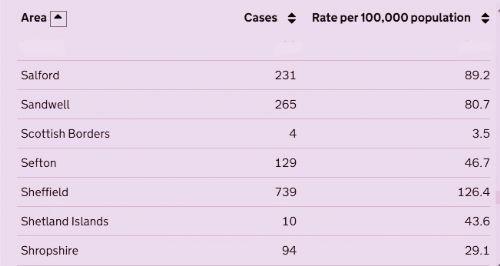
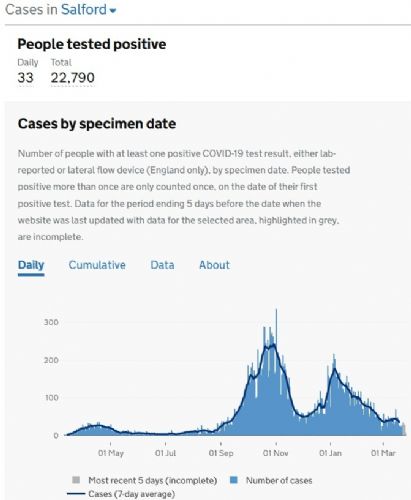
Salford has 33 new coronavirus cases, up from the previous day's 32, bringing the cumulative total to 22,790. The seven day average of cases in Salford is now 231, down from 273, while the seven day rate per 100,000 population now stands at 89.2, down from 105.5.
Elsewhere in Greater Manchester, the seven day average of cases in Bury is 165 (down from 184), with a seven day rate per 100,000 population of 86.4 (down from 96.3); Bolton 314 (up from 311), with a rate of 109.2 (up from 108.2); Manchester 502 (down from 504), with a rate of 90.8 (down from 91.2); and Oldham 256 (up from 254), with a rate of 108 (up from 107.1)..
Rochdale has a seven day average of cases of 246 (up from 222), with a seven day rate of 110.6 (up from 99.8); Stockport 224 (up from 220), with a rate of 76.3 (up from 75); Tameside 264 (down from 274), with a rate of 116.6 (down from 121); Trafford 119 (up from 104), with a rate of 50.1 (up from 43.8); and Wigan 341 (up from 339), with a rate of 103.8 (up from 103.1).
There have been no new virus-related deaths announced by Salford Royal Hospital.
Latest data shows just two patients admitted to Salford Royal with COVID-19 on 21st March, with fifty COVID patients in the hospital on 23rd March and five in intensive care.
Meanwhile, the Office for National Statistics carried out a COVID Test and Trace Cases Insights Survey between 1st and 13th February, showing that 86% of respondents fully adhered to self-isolation requirements overall. 37% of those people reported 'a negative effect on their well-being and mental health', and 32% reported having lost income.
Of those who had been working prior to self-isolation (either in or outside the home), 59% reported either working as normal or receiving full sick pay, while 13% were not paid during the isolation period. A further 8% received only statutory sick pay, 3% received reduced sick pay and 16% were not sure how they were paid
Approximately three in 20 people (14%) reported at least one activity during self-isolation that was not adherent to the requirements. Most breaches concerned trips to the shops, with going to work or college the second most popular reason, followed by medical appointments and exercise.
"Although it's a legal duty, self-isolation does disrupt day-to-day life, and we can see that there are key side effects of self-isolation such as worsening mental health and loss of income" says Tim Gibbs, Public Services Analysis Team, Office for National Statistics.
"Despite this, our analysis shows that a majority of people report fully adhering to the rules throughout their self-isolation period" he adds "This behaviour is vital in preventing the spread of COVID-19 and keeping people safe."
To read the full ONS report – click here


.jpg)
.jpg)
.jpg)


.jpg)


.jpg)
.jpg)
(3).jpeg)
.png)
(1).JPG)
