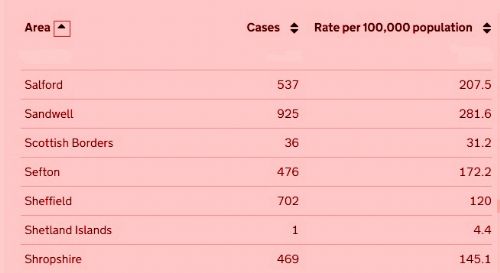
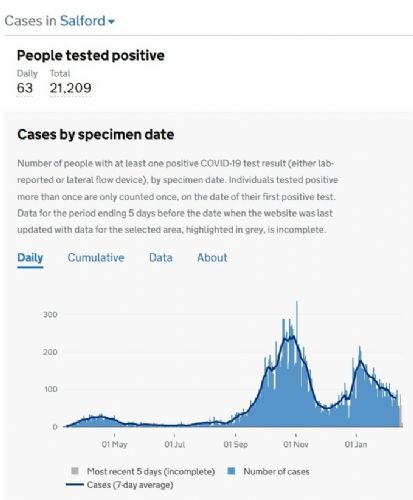
Salford has 63 new coronavirus cases, down from the previous day's 86, bringing the cumulative total to 21,209. The seven day average of cases in Salford has decreased to 537, down from 552, while the seven day rate per 100,000 population now stands at 207.5, down from 213.3.
Elsewhere in Greater Manchester, the seven day average of cases in Bury is 387 (down from 393), with a seven day rate per 100,000 population of 202.6 (down from 205.8); Bolton 679 (down from 746), with a rate of 236.1 (down from 259.4); Manchester 1,026 (down from 1,055), with a rate of 185.6 (down from 190.8); and Oldham 446 (up from 431), with a rate of 188.1 (up from 181.8).
Rochdale has a seven day average of cases of 396 (down from 406), with a seven day rate of 178 (down from 182.5); Stockport 545 (down from 560), with a rate of 185.7 (down from 190.9); Tameside 437 (down from 454), with a rate of 192.9 (down from 200.4); Trafford 328 (down from 331), with a rate of 138.2 (down from 139.5); and Wigan 577 (up from 575), with a rate of 175.6 (up from 175).
.
There have been no new virus-related deaths at Salford Royal Hospital.
20,467 doses of vaccine have been administered at the Salford Royal Hospital hub (10,214 to NHS staff, 1,217 to patients and 9,036 to other staff), while 32,739 doses of the vaccines have been given across the city's three community hubs and outreach sites. This totals 53,206, which means that around one quarter of adults in the city have now had the jab.
Meanwhile, a new report from UNISON shows how women in key worker positions across the North West are losing sleep, spending more on household bills, and worrying about the pandemic's impact on their children's education and mental health.
The findings in the Women Working Through the Pandemic report* are based on responses from almost 6,500 women, including teaching assistants, nurses, council workers and police staff.
More than two thirds (67%) of the respondents are not sleeping well, more than half (53%) are not taking regular breaks and 59% felt stressed most of the time. Of the women who are parents, three in five (62%) are worried about the mental health of their children and more than two fifths (45%) are concerned about how their education is being affected.
The vast majority (93%) also miss catching up with close friends in person, and many (52%) do not have time to reflect and de-stress. More than a third (37%) say that they are experiencing loneliness.
Just under half (49%) of the women surveyed earn £18,000 a year or less, and a more than a third (34%) earn £15,000 or less, yet more than half (53%) have seen their spending increase – especially on energy, food, technology, transport and housing – and just over a third (32%) had to dip into savings to cope with financial difficulties.
More than half (54%) said that being unable to get a regular hair cut or colour is affecting how they feel about themselves, while almost half (47%) are not exercising regularly. For more personal experiences see the case studies below.
"Public services would have come to a standstill without the vital jobs done by women in our schools, hospitals, police forces and local councils" says UNISON North West Regional Manager Jenny Martin "But employees are exhausted. They're worn out from meeting work demands during COVID while caring for relatives, looking after children and dealing with debt. Those on low wages are the ones shouldering these burdens most of all.
"All women deserve better and this country's economic recovery depends on them" she adds "But their mental and physical health is at stake. The Government needs to step up by providing the funding and support to make their working lives easier."
UNISON is calling for the Government to ensure employers offer staff more flexibility over when they work and not to take long hours for granted, to fund childcare properly so it's affordable and accessible for key workers, and to maintain the £20 increase to the universal credit allowance.
* To read the full report – click here
Case Studies with names changed...
Jennifer, a police support officer, says: "I've started suffering with anxiety. I've found it really hard to be out in the public, with people approaching me all day. We have masks, but many members of the public don't wear them or respect social distancing. Lots of people tell me, 'I don't believe in it' or 'It's not real'.
"It's tough at home too. I have two teenagers. My food bills are significantly higher as the kids are home all day and they're bored so they're eating more. I have no time to myself, whether it's at work or at home, I feel I'm always 'on'.
"I'm doing shift work, then cleaning and looking after the children, then it all starts again. There's just no space. My daughter has been rejected from her course at university because of the backlog of students from last year, which is really getting her down. I really worry about them. It's a constant juggling act."
Alice works on a mental health ward as an activity coordinator says: "I have a constant fear about coming into work. Particularly after several patients died. Your mental health takes a real battering. It's like walking into the gates of hell. My daughter is pregnant and works in the private care sector. I'm constantly worrying I might give the virus to her or she will catch it at work. Her employer hasn't even provided her with a risk assessment. It's shocking. I can't sleep at night because I'm so stressed about it all."
Sally is an ambulance care assistant, and says: "I was in the military and got paid danger money. In this job I'm risking my life every day for £10.94 an hour. The past year in the job has been harder than doing a tour in Afghanistan. It's mentally hard. I see families crying everyday as they welcome back loved ones who they thought they may not see again – some had said their goodbyes. I miss having my hair and eyebrows done too. I look like I've been sleeping rough. I just don't feel comfortable."




.jpg)


.jpg)
.jpg)
(3).jpeg)
.png)
(1).JPG)
