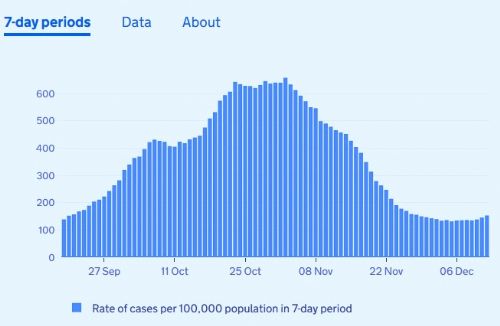
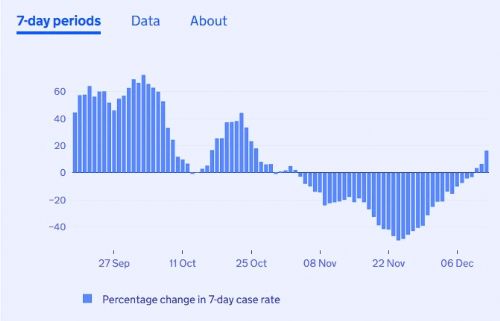
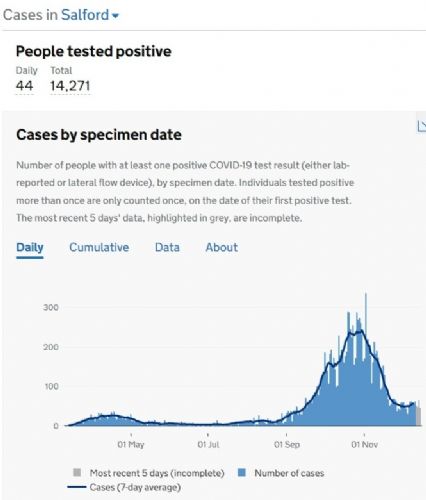
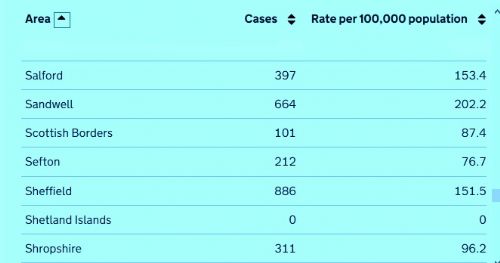
Salford has 44 new coronavirus cases, down from the previous day's 72, bringing the cumulative total to 14,271. The seven day average of cases has increased from 377 to 397, as has the seven day rate per 100,000 population which rose from 145.7 to 153.4.
Elsewhere in Greater Manchester, cases in Manchester during the latest seven day data period were 964 (down from 971), with a rate of 174.4 (down from 175.6), followed by Bolton with 421 (up from 400), with a rate of 146.4 (up from 139.1) and Oldham 431 (up from 418), with a rate of 181.8 (up from 176.3).
Wigan has a rate of 585 (up from 582), with a rate of 178 (up from 177.1), Tameside 207 (down from 214), with a rate of 91.4 (down from 94.5), Rochdale 461 (up from 447), with a rate of 207.3 (up from 201), Stockport 317 (down from 320), with a rate of 108 (down from 109.1), Bury 391 (down from 405), with a rate of 204.7 (down from 212.1) and Trafford 259 (down from 262), with a rate of 109.1 (down from 110.4).
There have been six new virus-related deaths at Salford Royal Hospital.
Meanwhile, the Government has officially laid out its reasons for keeping Greater Manchester under Tier 3 restrictions. It measures local statistics against its indicators...
"Since the end of national restrictions the situation in Greater Manchester has remained stable" it states "Case rates remain greater than 150 per 100,000 in Bury, Manchester, Oldham, Rochdale and Wigan.
"Case rates in over 60s are decreasing across the majority of the area but are above 150 per 100,000 in Bolton, Bury, Manchester, Oldham and Rochdale" it explains "Case rates are lowest in Tameside, Trafford and Stockport but the most recent data indicates that case rates are now plateauing or increasing, therefore any de-escalation of these areas would likely lead to cases increasing, particularly given the interconnectedness of these areas with the rest of Greater Manchester.
"Positivity remains high across the area but is falling" the Government adds "The epidemiology indicators remain too high for de-escalation to Tier 2. COVID admissions in Greater Manchester declining. Bed occupancy in line with the national average and critical care bed occupancy is not rising but remains high..."
Following yesterday's announcement, Greater Manchester Health Lead, Richard Leese, called the decision "Unbelievable", while Greater Manchester Mayor, Andy Burnham, claimed a southern bias (see previous Salford Star article – click here)
There has still been no official reaction from Salford City Mayor, Paul Dennett, nor Salford and Eccles MP Rebecca Long Bailey. Worsley and Eccles South MP Barbara Keeley merely re-tweeted Andy Burnham's tweet, while Blackley and Broughton MP Graham Stringer doesn't exist on social media...
Main image shows graph of 7 day case rates in Salford by specimen date to 12th December but published 17th December




.jpg)


.jpg)
.jpg)
(3).jpeg)
.png)
(1).JPG)
