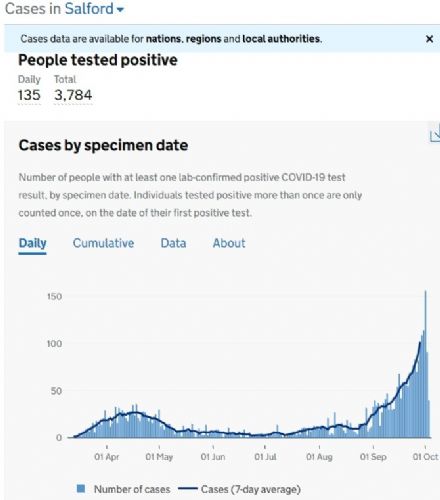
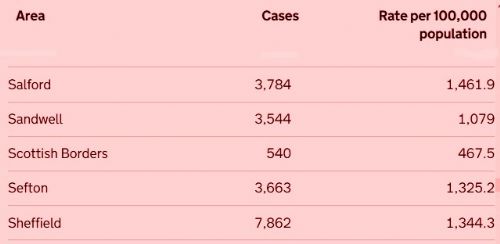
Salford has 135 new confirmed cases of coronavirus, bringing the cumulative total to 3,784, up from the previous day's 3,649.
Elsewhere in Greater Manchester, cases in Manchester rose to 10,237 (up from 9,824), followed by Bolton 5,436 (up from 5,312), Oldham with 4,773 (up from 4,688), Wigan 4,190 (up from 4,063), Rochdale 3,995 (up from 3,857), Tameside 3,494 (up from 3,398), Stockport 3,252 (up from 3,169), Trafford 2,866 (up from 2,773) and Bury 3,110 (up from 3,023).
There have been no new deaths announced at Salford Royal Hospital.
Meanwhile, the World Health Organisation's Director for Europe, Dr Hans Henri P Kluge, has issued a statement about growing concern over COVID-19 fatigue...
"Since the virus arrived in the European Region eight months ago, citizens have made huge sacrifices to contain COVID-19" he says "It has come at an extraordinary cost, which has exhausted all of us, regardless of where we live, or what we do. In such circumstances it is easy and natural to feel apathetic and demotivated, to experience fatigue.
"Based on aggregated survey data from countries across the Region, we can see, not surprisingly, that fatigue among those surveyed is increasing" he explains "Although fatigue is measured in different ways, and levels vary per country, it is now estimated to have reached over 60% in some cases."
He gives three strategies to "reinvigorate and revive efforts to tackle the evolving COVID-19 challenges that we face...." These are...
* Take the pulse of the community regularly, and use what you find...
This is about local councils measuring "the degree to which individuals perceive risk of the disease, their protective behaviours and the degree to which they adhere to social policies and measures"'.
The WHO gives the example of Hertfordshire where the council has an online platform to "measure community feelings and comfort with indoor and outdoor settings, and health service provision is adjusted accordingly". In Germany, they use philosophers, historians, theologians and behavioural and social scientists, as well as medical experts, to try to sort issues like "the legitimacy of restrictions, and the balance between public support and moral norms versus coercive state action".
* Co-create interventions with the community...
"Consultation, participation and an acknowledgement of the hardships that people are facing are key if we are to have truly effective policies" the WHO states "The community should be considered a resource, as well as a recipient or beneficiary."
In Denmark, students gave advice on how to open universities safely while preserving the student experience, while in Norway, nursery nurses developed guidance for safe reopening of nurseries... "We are seeing growing ingenuity, innovation and an emphasis on citizen participation, with great results" states the WHO "Citizens are at the heart of a solution to the pandemic and policy-makers should treat them as such..."
* We need to meet our needs in new, safer ways...
With Christmas and other festivities fast approaching, the WHO argues that "Creative approaches can restore social pleasure while protecting communities. We have seen the effectiveness of floating cinemas, new format cultural events and social bubbles.
"By balancing science, social and political needs we can develop precautionary measures that are culturally accepted" it adds "Every sector and every citizen has a role to play as we find a way to enjoy this important time of year while protecting our communities."
It all looks like common sense. It is just hoped that councils and governments take on board the advice...




.jpg)


.jpg)
.jpg)
(3).jpeg)
.png)
(1).JPG)
